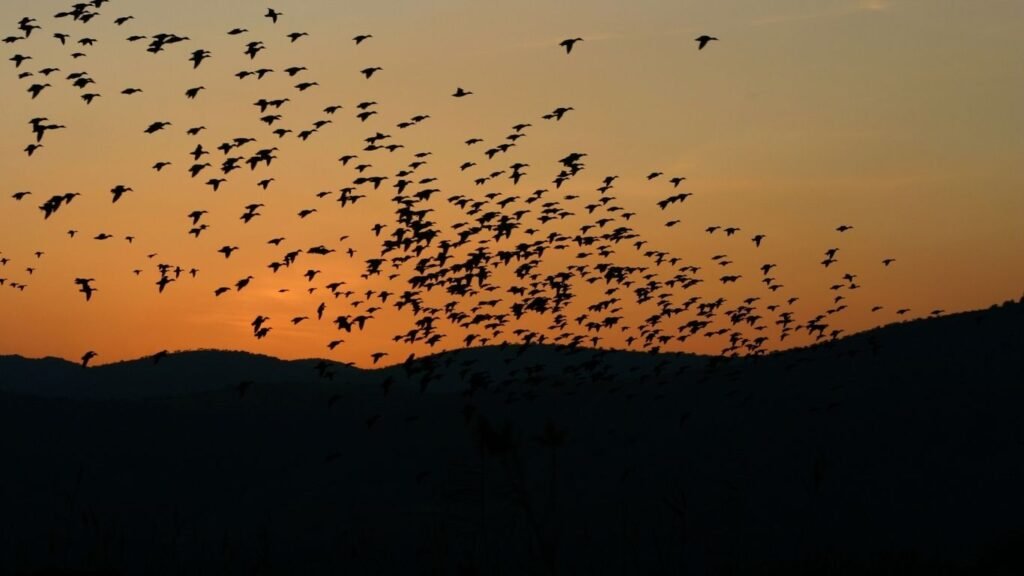
Have you ever noticed on certain seasons there are fewer birds in the sky then other seasons? It’s because those birds are migratory birds. What is migration? Well, simply put, migration is the large-scale, long-distance movement of organisms from one region or habitat to another. Many creatures, from marine to land animals, migrate for better food sources, better habitats, mating, laying eggs, and seasonal changes.
Birds make some of the longest and most precise journeys on Earth. Every year, millions fly hundreds or thousands of miles between breeding grounds and winter homes. Some, like the Arctic tern, travel from the Arctic all the way to the Antarctic and back.
Young birds on their first migration migrate without the help of their parents and still reach the same stop; how do they do it? It’s not just one thing, like they just remember the exact path, but a mix of many ecological and biological factors that help them reach their destination. Scientists call this a combination of orientation (knowing which direction to fly) and navigation (knowing where they are and how to reach a goal).
Why birds migrate and how they know when to start
Birds migrate mainly to find food and better weather. In spring, they head to places with long days and plenty of insects or plants for raising chicks. In autumn, they fly to warmer areas where food is still available.
Birds know when to migrate thanks to an internal clock that tells them when to start. Changes in day length (how many hours of daylight there are) are the strongest signal. Temperature and food supplies also play a role. Young birds in captivity also start fluttering in the right season toward a direction. It shows that the urge and the basic direction are built into their genes.
The tools birds use to find their way
Birds don’t use just one tool; they combine several natural “compasses” and “maps.”
1. The Sun compass
During the day, birds use sun as a guide for their journey. Many birds use the sun’s position. The sun moves across the sky, so birds also use their internal body clock (circadian rhythm) to adjust. If the sun is in a certain place at 9 a.m., they know it means something different than at 3 p.m. Experiments with mirrors that shift the apparent position of the sun make captive birds fly the wrong way. Even on partly cloudy days, birds can sense polarized light patterns in the sky that help them keep track of the sun’s direction.
2. The star compass
Most songbirds migrate at night. They look at the stars. Young birds learn by watching how the stars rotate around the North Star (Polaris). The center of that rotation tells them which way is north. Classic experiments in planetariums showed that when scientists rotated the artificial sky, the birds changed direction to match. They do not need to memorize every constellation — the pattern of rotation is enough.
3. Earth’s magnetic field
Birds can sense the Earth’s magnetic field, a sense called magnetoreception. The field runs roughly north-south and also changes in strength and angle (inclination) from the equator to the poles. This gives birds both a compass (direction) and part of a map (rough location).
Scientists believe there are at least two ways this works:
- Special proteins called cryptochromes in the birds’ eyes. When blue light hits these proteins, they create short-lived chemical pairs (radical pairs) that are sensitive to magnetic fields. This may let birds “see” magnetic information.
- Tiny amounts of magnetic material (magnetite) in or near the beak that may help sense the strength of the field.
The magnetic compass works even on cloudy nights when the sun and stars are hidden. It is especially useful for long ocean crossings where there are few landmarks.
4. Landmarks
Once birds have traveled a route before, they remember rivers, mountain ranges, coastlines, lakes, and other visible features. Day-migrating birds such as hawks and eagles often follow mountain ridges or shorelines. Even night migrants can use large features when they are close to their destination.
5. Smell
Some birds, especially seabirds, use their sense of smell. Different places have different mixes of odors carried on the wind. Birds can build a kind of “smell map.” Experiments show that when scientists block a bird’s sense of smell, its ability to find the way home over open water gets worse.
6. Other possible cues
Birds may also notice wind patterns, air pressure changes, low-frequency sounds (infrasound) that travel long distances, and the way polarized light looks at sunrise and sunset. These extra clues help fine-tune the journey.
How young birds and adult birds differ
Young birds on their first migration usually follow an inherited program: “Fly southwest for a certain number of days” or a similar simple instruction. This is called the clock-and-compass or vector navigation method. It gets them into the right general region.
Adult birds that have made the trip before can do something more advanced. They use true navigation. If they are blown off course by a storm, they can figure out where they are and correct their path to reach the exact wintering or breeding spot. Classic experiments in the 1950s with starlings showed this clearly: young birds continued in the same direction after being moved, while adults adjusted their course toward the real destination.
Conclusion
Birds do not use on only one sense. They constantly cross-check. On a clear night, they might use stars and the magnetic field. On a cloudy day, they lean more on magnetism and landmarks. Near the end of the journey, they use familiar sights and smells for the final approach. If one cue fails, others take over.
This multi-tool system is why birds can return year after year to the same small patch of habitat, sometimes even the same nest site. It is one of nature’s most impressive achievements — a natural GPS built from sun, stars, magnetism, memory, and smell, all working together inside a creature that weighs only a few ounces.