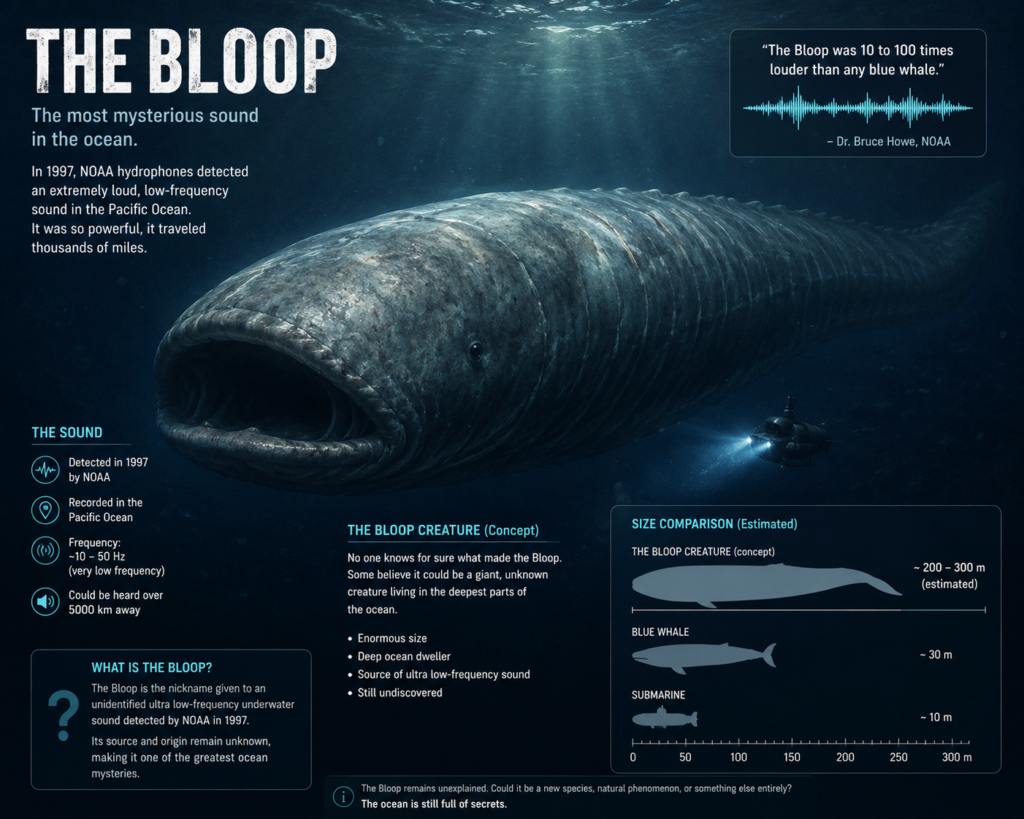
The Bloop was a mysterious sound so powerful that it travelled through the depths of the ocean and was detected by hydrophones thousands of miles apart. Its strange nature captured people’s imagination and gave rise to one of the most famous mythical explanations for an unexplained sound: a gigantic creature lurking beneath the sea. People have always been drawn to fictional answers when science doesn’t yet have an explanation, and the Bloop is a fascinating example of this.
What is it?
The Bloop was an ultra-low-frequency, high-amplitude underwater sound detected by the National Oceanic and Atmospheric Administration (NOAA) in 1997 in the South Pacific Ocean. It was so loud that it was heard across 5000 km by hydrophones (underwater microphones). The strangest part was that the scientists had no idea what made this sound. At first, scientists thought it was a marine creature, and its unusual sound characteristics initially led some people to speculate that it might have come from a marine animal. The sound was extraordinarily powerful, leading to speculation about whether an animal could have produced it.
This uncertainty made the Bloop famous.
Why was it mysterious?
When the sound recording was first analysed, the sound seemed very unusual; it was so loud, travelled so far through the ocean, and scientists were unable to find the source. Because nobody knew how this sound came into being, people started creating unrealistic theories that went far beyond scientific evidence.
The leap from an unidentified sound to an unrealistic creature living beneath the ocean was fueled by a combination of the sound’s characteristics and the human imagination. The acoustics of the bloop had an undulating frequency that bore a slight resemblance to whale calls. But for it to be heard thousands of kilometres apart in the ocean, it had to be far more powerful than any known animal sound on Earth. The scale was one of the key points for the “giant creature” theory.
The biggest myth: a giant sea creature
Because much of the deep ocean remains difficult to explore, the idea of an undiscovered creature living there didn’t seem completely impossible to the public. The vastness of the ocean and its mystery have always been a fertile ground for myths of sea monsters and creatures like the Kraken. The most popular theories were that the Bloop came from a massive unknown sea creature. People imagined something much larger than a blue whale—sometimes comparing it to Cthulhu, the fictional cosmic sea monster created by H. P. Lovecraft. The idea became especially popular because the Bloop’s location was coincidentally close to the fictional location of R’lyeh, Cthulhu’s supposed underwater city.
There is no scientific evidence that a giant creature produced the Bloop.
The real culprit
This is where the story gets interesting. For years, the bloop remained an enigma, a mystery unsolved by science, but the scientific process eventually caught up with the myth. By deploying more hydrophones around the Antarctic regions, researchers discovered the source of the sound.
In 2005, NOAA researchers identified the sound as an icequake caused by large Antarctic icebergs cracking and breaking away from glaciers, particularly the cracking and breaking of large Antarctic icebergs and glaciers. This is a phenomenon caused by the cracking, fracturing, and breaking away (calving) of large icebergs from Antarctic glaciers. These events generate immense acoustic energy that can travel thousands of kilometres through the ocean, exactly matching the sound profile of bloop. NOAA now records many similar ice-related sounds, helping scientists study how glaciers and icebergs behave and change over time.
Conclusion
The bloop is one of the best case studies on how a scientific mystery can morph into a modern myth. How a mysterious sound, unknown to science, makes people create a mythical monster. While the science behind it is grounded, the myth still persists. Despite the scientific explanation, the myth of the Bloop monster persists. This is partly because a dramatic explanation is simply more memorable than a scientific one. The Bloop’s story is a powerful reminder that our fascination with the unknown can sometimes lead us to overlook more ordinary, but equally fascinating, truths about our planet.
Source:- NOAA – The Bloop