Intro
When we think about radiation, images of the Second World War come to mind. The destruction left behind by nuclear bombs on Hiroshima and Nagasaki, and its effects even years later. After all, nuclear weapons produce enormous amounts of radiation along with heat, blast, and radioactive fallout.
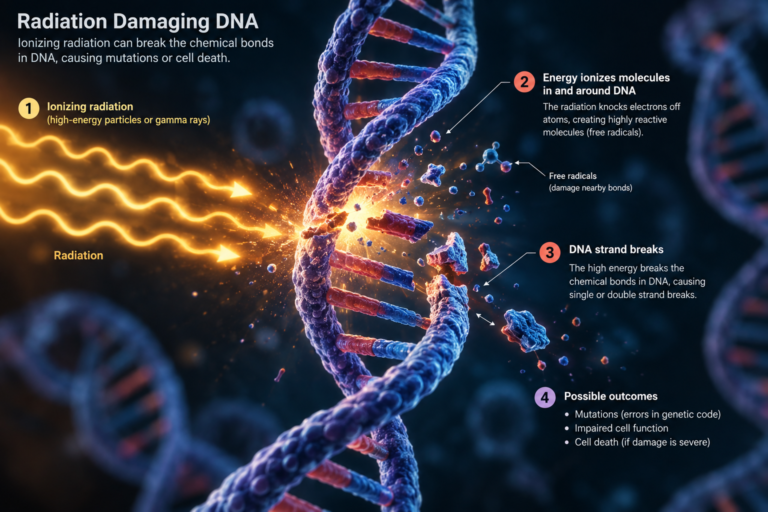
But does radiation really do all of it? Nuclear radiation does affect DNA really badly if exposed for a long time, but it depends on the type of radiation and exposure. We experience radiation daily. Generally, radiation has a lower risk at lower doses, but higher doses have higher risks. It depends on the type of radiation, so we take different measures to protect our bodies and the environment from its effects while still benefiting from its many applications.
What is it
Radiation is energy in transit, where energy travels through space or matter as a particle or wave. Simply put, radiation is energy travelling from one place to another. It is a natural consequence of our universe: any object with a temperature above absolute zero emits some form of radiation.
Types of radiation
Scientists divide radiation into two broad categories based on its energy to knock electrons out of atoms. Non-Ionizing radiation and Ionizing radiation.
Non-ionizing radiation does not have enough energy per photon to ionize atoms. Depending on its frequency and intensity, it can interact with matter in different ways—for example, microwaves can heat materials, while visible light can be absorbed or reflected.
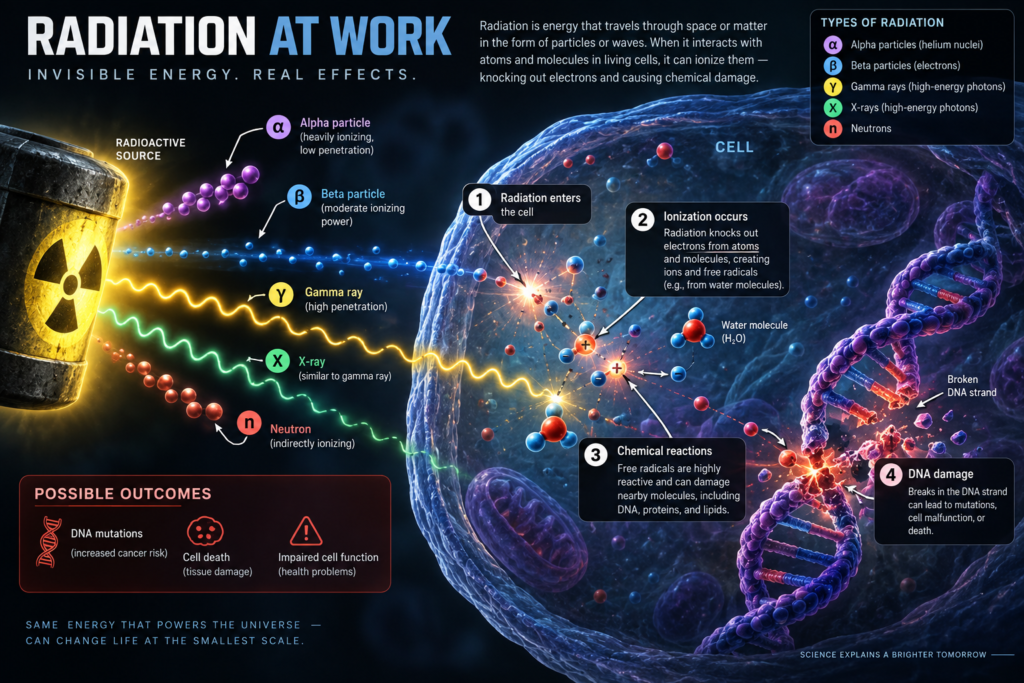
Ionizing radiation can be lethal to humans if they come into contact with it for a long time or in high doses over a short time frame. It can also knock the electrons out of the atom. This includes X-rays, gamma rays, and high-energy particles like alpha and beta particles and neutrons.
The key distinction is ionizing vs. non-ionizing: ionizing radiation (X-rays, gamma rays, particles) can damage atoms and DNA; non-ionizing radiation (radio waves, microwaves, visible light) generally cannot.
How does it work?
Some atomic nuclei are unstable because of their particular combination of protons and neutrons. To become more stable, they can release energy or particles through radioactive decay. Radiation is produced whenever energy is released from an unstable source.
Radiation can take two broad forms:
Electromagnetic radiation is emitted when charged particles accelerate or when an atom’s electrons drop from a higher to a lower energy state. It travels as waves at the speed of light and spans a vast spectrum: from long-wavelength radio waves at the low-energy end, through microwaves, infrared, visible light, and UV, up to X-rays and gamma rays at the high-energy end.
All of these are the same fundamental phenomenon — electromagnetic waves — just at different frequencies and energies. Non-ionizing forms sit on the low-energy side; ionizing forms sit on the high-energy side.
Particle radiation comes from unstable atomic nuclei. When a nucleus is too heavy or has the wrong balance of protons and neutrons, it decays and releases energy in the form of particles. Alpha particles are heavy, slow, and easily stopped by a sheet of paper or skin, but dangerous if inhaled or ingested. They can penetrate a few millimetres into tissue and can be reduced using materials such as plastic or other appropriate shielding.
Beta particles are much lighter and can penetrate a few millimetres into tissue. Materials such as plastic can be used for shielding.
Neutrons are uncharged and highly penetrating, requiring thick concrete or water for shielding.
Radioactive decay is the source of most concern in discussions of nuclear radiation. It happens because certain combinations of protons and neutrons are unstable, and it sheds energy till it reaches a stable form.
Common Misconceptions
There are many misconceptions towards nuclear radiation, such as that any kind of radiation is very dangerous to humans. That radiation makes things radioactive. That microwaves make food radioactive, and that radiation only comes from nuclear power plants. They are not true at all; only ionizing radiation is dangerous to the human body, and only if it has enough energy to knock electrons out of your cells’ atoms.
Radiation exposure does not automatically make an object radioactive. An X-ray does not make your body radioactive. However, certain types of radiation, particularly neutrons, can make some materials radioactive through a process called neutron activation. Microwaves only vibrate the water molecules in the food to heat it up, and it uses non-ionizing radiation to do that. And Nuclear power is a minor contributor to average public exposure. The bigger sources are medical procedures (like CT scans and X-rays), radon, and cosmic radiation — with nuclear power contributing a very small fraction.
Conclusion
Nuclear radiation can be dangerous, but it is neither good nor evil; its effects depend entirely on its type, energy, the dose received, and how the exposure occurs. Radiation is energy in transit, carried by waves or particles moving through space or matter. The critical distinction is whether the radiation is ionizing—capable of removing electrons from atoms—or non-ionizing, which generally does not have enough energy per photon to do so.