If there were an Olympic gold medal for persistent global myths, the idea that the Great Wall of China is visible from space with the naked eye would be on top. The Great Wall is a magnificent human achievement, but its dimensions and its colours make it effectively invisible to the human eye from space. And it’s impossible to see from the Moon.
The short answer is: No, you cannot reliably see the Great Wall of China from space with the naked eye—and it is definitely not visible from the Moon.
Where the myth came from
The idea is older than spaceflight. In 1754, the English antiquarian William Stukeley wrote that the Chinese wall could be seen from the Moon. Another early version appeared in the essayist Henry Norman in 1895. The claim spread widely in the 1930s: a 1932 Ripley’s Believe It or Not! cartoon called the wall the only human work visible from the Moon. And Richard Halliburton repeated a similar claim in a 1938 book. Nobody had left the atmosphere yet, so nobody could check.
The myth appears to have taken root during the Gemini missions of the 1960s, when astronauts in low Earth orbit were able to identify some large man-made features on the ground. Buzz Aldrin, who walked on the Moon, later said he never saw the Wall from the lunar surface and doubted any human could, attributing the tale’s origin to the Gemini flights, which were ‘much closer to Earth. The New York Times even corrected itself on the matter in 1983, admitting it had “innocently repeated what turns out to be an old savant’s tale”.
Why it Sounds Believable and Why it Doesn’t Hold Up
The wall is enormous. Surveys put its total length at about 21,196 km (13,171 miles). But length isn’t what matters for visibility. The wall is less than 10 meters wide, even at its widest. From the International Space Station, which orbits at an altitude of about 300 to 400 kilometres, a 6-metre-wide object is far below the resolution limit of human vision. The wall’s colour is typically grey or earth-toned, which blends almost perfectly with the surrounding soil and vegetation. Contrast is everything in visual perception, and the Great Wall offers almost none from orbit.
Former shuttle astronaut Jeffrey Hoffman said he flew over China many times and never saw the wall, facing the same contrast problem. The wall is built of stone and clay, and in many places it is crumbling. Hoffman added that he couldn’t pick out the Egyptian pyramids for the same reason, but he could see roads, runways and irrigation ditches because they stand out from their surroundings.
What the Astronauts Actually Said
The most direct and culturally significant testimony comes from China’s first astronaut, Yang Liwei. During his 2003 Shenzhou 5 mission, a television host asked him the question that many Chinese had wondered about: did he see the Great Wall? His answer was unambiguous: “The Earth looked very beautiful from space, but I did not see our Great Wall”. Yang later added that even straining to look, he could not see the wall.
The best proof comes from NASA astronaut Leroy Chiao aboard the International Space Station. On November 24, 2004, he photographed central Inner Mongolia, about 200 miles north of Beijing, and NASA confirmed the image shows sections of the wall. He used a digital camera with a 180mm lens. A second shot of the Badaling section near Beijing followed on February 20, 2005, from an altitude of about 360 km. NASA published an article about the photo, with red arrows marking the visible stretches of the wall.
What about satellites and radar?
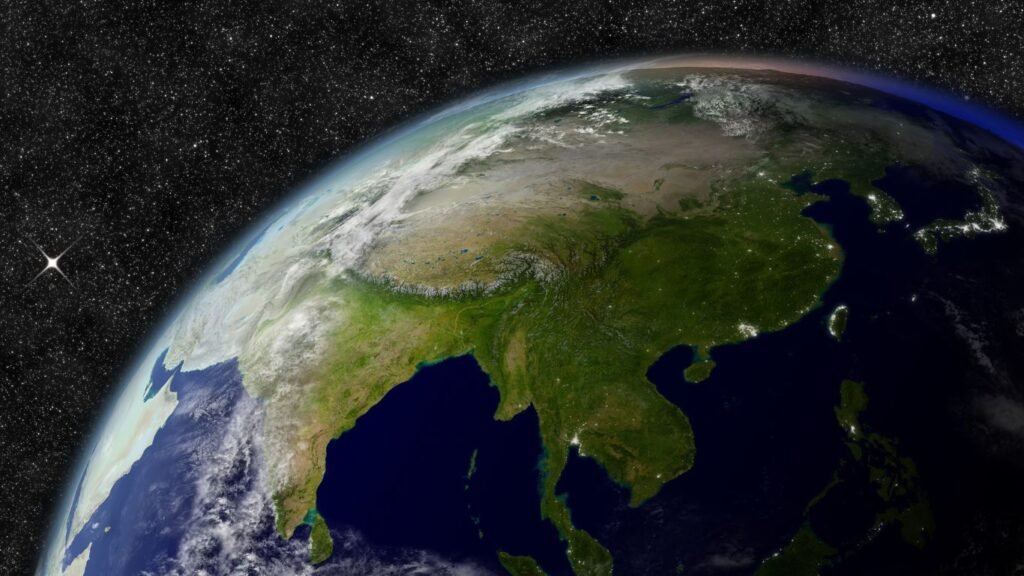
Machines can do better, but not effortlessly. The U.S. Geological Survey says its Landsat satellites, orbiting about 705 km up, can usually pick out the wall only under specific conditions. In one case, snow had been cleared from the wall but covered the fields beside it, creating the contrast needed. The wall can also be made out in radar images taken from space, though not in ordinary photographs. Pollution doesn’t help: Hoffman noted that smog over much of China makes it almost impossible to see anything from orbit.
Conclusion
The Great Wall of China is an extraordinary engineering and historical achievement, stretching thousands of kilometres across varied terrain. Its length does not make it visible from space to the naked eye. From the Moon, it is invisible; from low Earth orbit, it is extremely difficult or impossible to see without optical aid and ideal conditions. The myth is false, and the real view from orbit reveals a different, more varied human footprint on the planet.