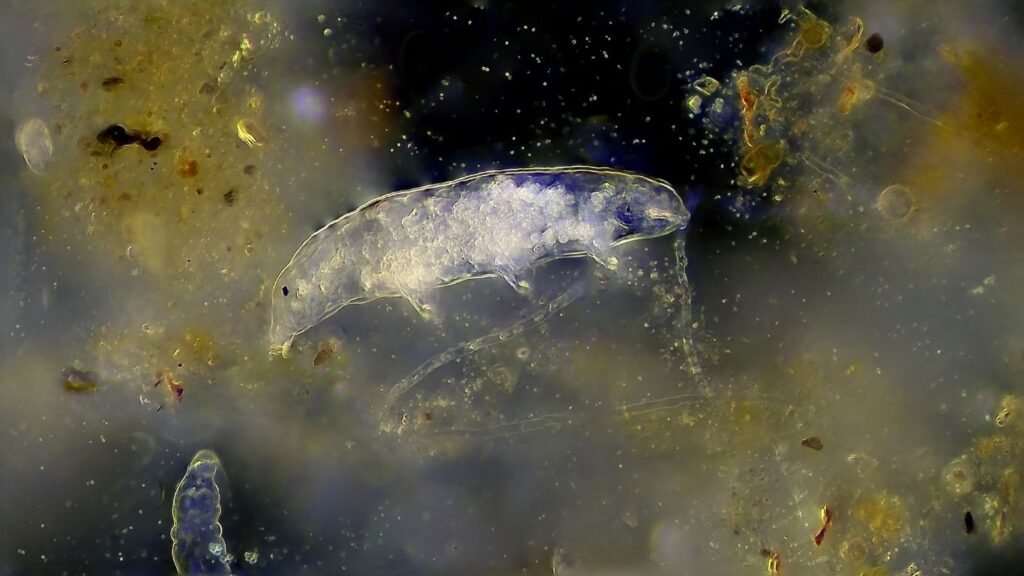
Tardigrades, commonly called water bears or moss piglets, are microscopic, eight-legged invertebrates renowned for their extraordinary ability to survive conditions that would kill nearly all other animals. They are not true extremophiles that thrive in harsh environments, but extremo-tolerant organisms that endure extremes by entering dormant states and then resuming normal activity when conditions improve.
What is a Tardigrade?
Tardigrades belong to their own animal group, called the phylum Tardigrada. They are microscopic animals with segmented bodies and four pairs of short legs, usually ending in claws or adhesive pads. Most adults measure around 0.05 to 0.5 mm long, although some species grow larger.
Unlike humans, tardigrades have no lungs or circulatory system. Oxygen passes into their bodies through diffusion, while nutrients are distributed through their body fluids.
The German zoologist Johann August Ephraim Goeze first described tardigrades in 1773, calling them Kleiner Wasserbär, meaning “little water bear.” The Italian biologist Lazzaro Spallanzani later introduced the name Tardigrada, which means “slow steppers.” Sources differ on whether he named them in 1776 or 1777.
Tardigrades belong to a large animal group called Ecdysozoa, which also includes arthropods, such as insects and spiders, and nematodes, commonly known as roundworms. They are also closely associated with arthropods and velvet worms in evolutionary classifications, although the exact relationships between these groups remain a subject of scientific research.
Scientists have described approximately 1,500 species of tardigrades. The exact number changes as researchers discover new species and revise existing classifications.
Habitat
Tardigrades live all over the world, from polar regions and high mountains to forests, freshwater environments and the deep sea. Many land-dwelling species live in the thin films of water that coat mosses, lichens and soil particles.
Although they can survive periods of dryness by entering a dormant state, these tardigrades generally need a film of water around them to remain active. Marine species, meanwhile, live in seawater, from shallow coastal habitats to the deep ocean.
Survival of Extreme Conditions: Cryptobiosis
The key to tardigrades’ remarkable resilience is cryptobiosis—a reversible state in which their metabolic activity becomes extremely low, sometimes undetectable using available methods. In this state, they can survive conditions that would otherwise be fatal.
One of the best-known forms is anhydrobiosis, which occurs when water becomes scarce. Other forms of cryptobiosis are associated with freezing, high concentrations of dissolved substances, or a lack of oxygen.
During anhydrobiosis, a tardigrade contracts its body and pulls in its legs, forming a compact, barrel-shaped structure called a tun. It loses most of its body water, allowing it to withstand drying that would kill many other animals.
Some tardigrades have survived in this dormant state for years, and certain laboratory or preserved specimens have been revived after exceptionally long periods. However, survival depends on the species and the conditions involved, so these records should not be taken as a typical lifespan.
Because many biological processes slow dramatically during dormancy, aging may also slow. However, it is too simplistic to say that the animal’s internal clock completely stops under all conditions. When water and suitable conditions return, a surviving tardigrade can become active again.
Limitations and Ecological Context
Despite their extraordinary resilience, tardigrades are not invincible. When active, they can be eaten by predators such as nematodes and other microscopic animals. They can also die from unsuitable environmental conditions, prolonged shortages of food or oxygen, and combinations of stresses that exceed their tolerance.
Survival is not guaranteed, either. Some individuals die during extreme conditions or fail to recover after dormancy. Tardigrades do not thrive in every harsh environment; their ability to enter dormant states allows some of them to endure difficult conditions until the environment becomes suitable again.
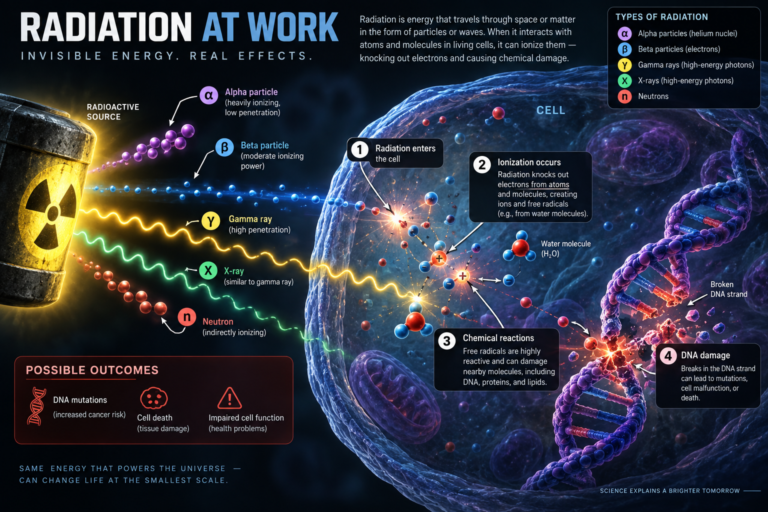
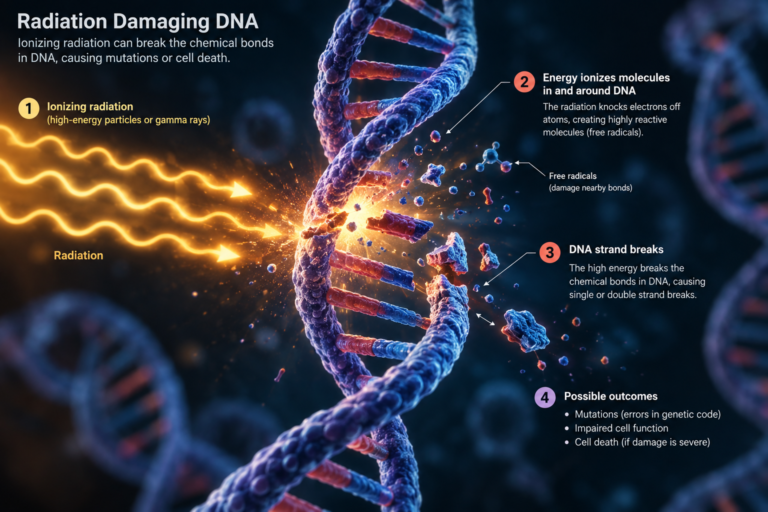
Their unusual survival mechanisms make them valuable subjects for research into desiccation tolerance, DNA protection and radiation biology. Scientists are also investigating whether these mechanisms could eventually help improve the storage of biological materials and advance research in biotechnology and astrobiology.
Conclusion
Tardigrades are remarkable not because they can survive absolutely anything, but because some species can enter dormant states that help them endure conditions that would be fatal to many other animals.
By studying how tardigrades protect their cells and tolerate the loss of water, scientists hope to develop new ways to preserve biological materials, improve the stress tolerance of crops and better understand how living organisms respond to radiation. Tardigrade proteins, including Dsup, are being investigated for potential applications, but protecting human astronauts from cosmic radiation or preserving human organs using these mechanisms remains a research challenge.
These tiny animals still have much to teach us. Their survival strategies show how life can adapt to extreme conditions—and may one day inspire useful advances in medicine and biotechnology.