Intro
Whenever people think about nuclear radiation, images of Chornobyl, mutated creatures, and superheroes made from radioactive accidents come to mind. But it’s not true in real life. Nuclear radiation is quite harmful to the human body, to the point of being life-threatening. But how does Nuclear radiation really affects the human body, “But how does nuclear radiation really affect the human body? Does it really change our genes in an instant, like in the movies?” To really understand how it affects humans, you have to understand its interaction with the most precious molecule in your cells — DNA.
What is it?
What is Nuclear Radiation
Nuclear radiation has two types: ionizing radiation and non-ionizing radiation. Ionising radiation has enough energy to strip electrons from atoms. This sets it apart from non-ionizing radiation like microwaves and radio waves, which lack the energy to break chemical bonds. This is what makes ionizing radiation potentially dangerous to living tissue: its energy is sufficient to directly disrupt molecular structures — and one of the most important molecules in your cells is DNA.
What is DNA?
DNA (deoxyribonucleic acid) is the long, double-stranded molecule that stores the hereditary instructions used in the development, functioning, growth, and reproduction of all known living organisms and many viruses. It serves as the chemical instruction manual for life. DNA passes genetic traits from parents to offspring, ensuring biological continuity across generations. And nuclear radiation, like ionizing radiation destroy this exact point.
How does it work?
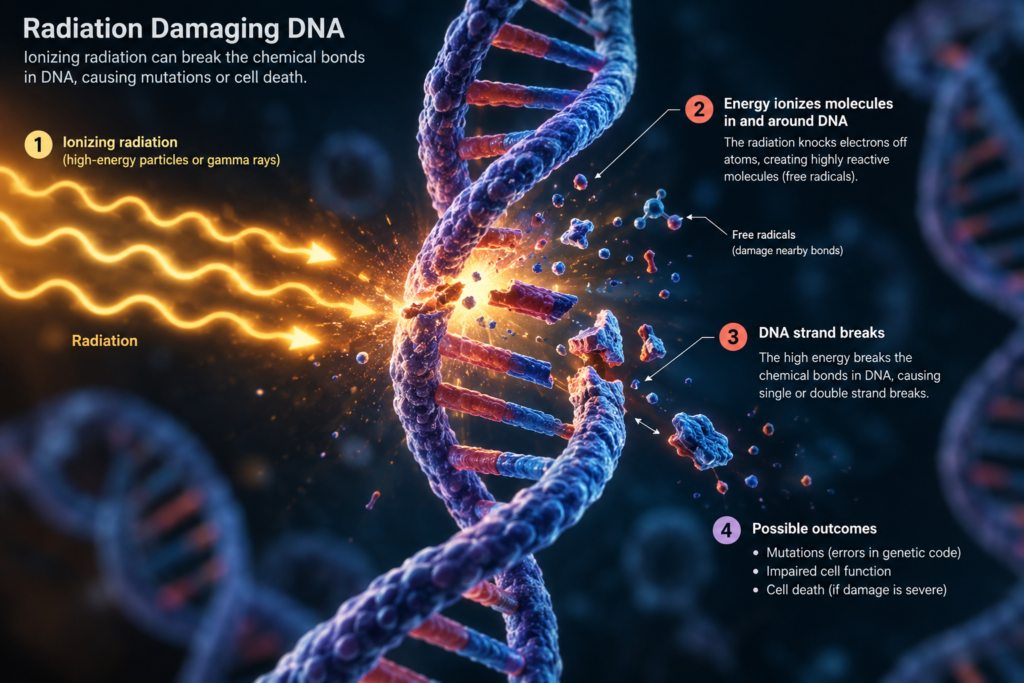
Nuclear radiation damages DNA through two main pathways.
Direct Damage: happens when a particle or ray strikes the DNA molecule directly. This snaps the DNA strands or breaks the bonds between the bases, causing single-strand or even double-strand breaks.
Indirect Damage: is more subtle and more common; human body is 70% water, so “Radiation can split water molecules, producing highly reactive molecules called free radicals, including the hydroxyl radical (•OH).” “These reactive molecules can chemically alter DNA bases, changing their structure or causing them to be removed from the DNA strand.”, or it literally rips the bases off the backbone.
What happens when DNA is damaged
Once the DNA is damaged (whether directly or indirectly), the cell tries to repair it. But radiation damage is often messy. The cell’s repair proteins rush to the site to stitch the breaks back together. Depending on how severe the damage is, several things can happen.
First, the cell starts repairing itself and returns to normal. Second, repair fails or is done incorrectly, leaving a permanent change (mutation) in DNA. If that mutation hits the genes controlling cell growth, then it will multiply rapidly and eventually become cancerous. And third, the damage is so severe that the cell just can’t repair it; then, to save the organism, the cell activates a suicide protocol, a kill switch, to prevent a severely damaged cell from surviving and potentially causing further problems. This is called apoptosis.
The body can tolerate and replace a small number of dead cells, but widespread cell death leads to organ failure — which is exactly what happens in acute radiation syndrome.
Not all radiation just outright kills people; it all depends on the dose. Low-dose radiation (like the natural background radiation we all receive daily) has a negligible effect on the body. The real risk comes from high-dose exposure in a short time. How the radiation is delivered also matters: the same dose is far more harmful if received all at once rather than spread over a long period, and whole-body exposure is more dangerous than localised exposure.
Conclusion
Nuclear radiation can be dangerous because ionizing radiation can damage DNA and other important molecules inside our cells. But the outcome depends heavily on the type of radiation, the dose, how quickly that dose is received, and which parts of the body are exposed. Small exposures may cause little damage, while a large dose received in a short time can overwhelm the body’s ability to repair itself and lead to severe illness.
Radiation doesn’t instantly rewrite your genes like it does in the movies. Instead, it damages molecules inside cells, and what happens next depends on how much damage occurs and how well the body can repair it.
Source
letstalksciecen – Radiation effects on cells DNA