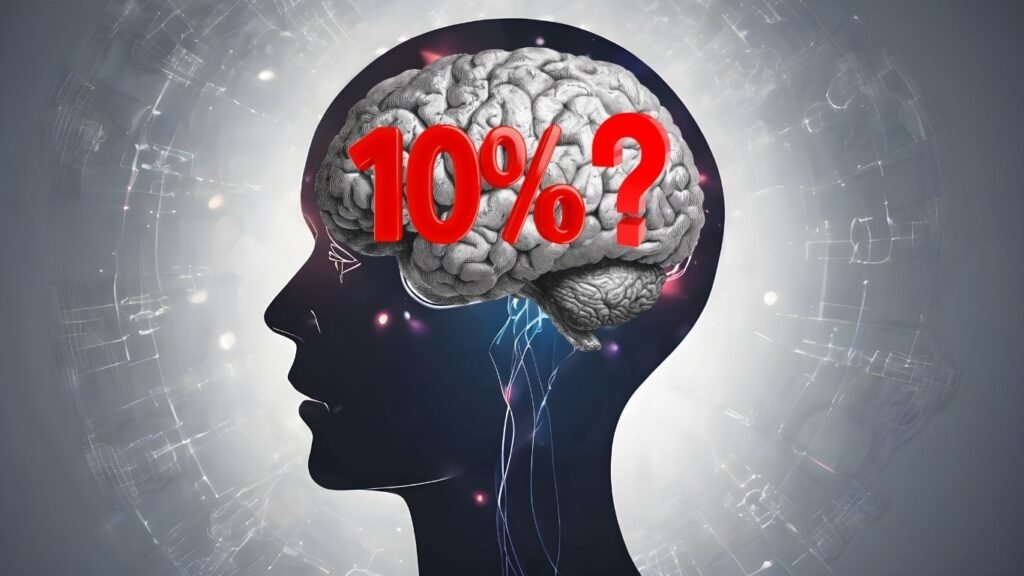
I believe you have heard about how humans only use 10% of their whole brain, not tapping the remaining 90% of their potential throughout their whole life. This quote really does sound too good to be true, and I must say this isn’t. This is a total myth and one of the biggest scientific myths ever popularized. It’s been repeated by teachers, motivational speakers, and Hollywood blockbusters like Lucy.
What is it?
The claim sounds very simple: people use only 10% of their brain, keeping the other 90% dormant and unused. According to this idea, if anyone somehow ‘activates’ this other 90% of the brain, it will give the person genius-level intelligence, psychic abilities, or superhuman powers. The myth has appeared in countless self-help books, advertisements, and films, presented as established scientific fact.
But the reality is vastly different. Advanced neuroimaging techniques such as fMRI and PET scans show that we use all of our brain virtually over the course of a normal day. Different regions become more or less active depending on what we’re doing, thinking, or experiencing, but the idea that 90% of the brain sits completely unused is not supported by neuroscience. As one neuroscientist put it, if you only used 10% of your brain, “you’d probably be connected to a ventilator”.
How did this myth started?
Exactly identifying who started this myth or how it began is kind of tricky, since it likely emerged from multiple sources that blended over time.
The William James Misquote
The most commonly cited source is American psychologist William James, often called the “father of American psychology.” In his 1907 essay The Energies of Men, James wrote that people “habitually use only a small part of their powers which they actually possess”. Crucially, James was talking about mental and physical potential, not brain usage. He never mentioned a specific percentage, and he never claimed we only use 10% of our brains.
The number itself seems to have been introduced later. In 1936, journalist Lowell Thomas wrote the foreword to Dale Carnegie’s mega-bestseller How to Win Friends and Influence People, claiming: “Professor William James of Harvard used to say that the average person develops only 10 per cent of his latent mental ability”. This attribution—which James never actually said—put a specific number on a vague idea, and the myth was born.
Misinterpretation of Early Brain Research
Another contributor was early 20th-century neuroscience itself. Researchers like Karl Lashley conducted experiments on rats, finding they could still perform tasks after portions of their cortex were removed. Additionally, early neurophysiologists used the term “silent cortex” to describe brain regions that didn’t produce obvious responses to sensory stimulation or motor tasks. This technical term meant these areas weren’t involved in those specific functions—not that they were useless. These experiments were sometimes later misinterpreted as evidence that large parts of the brain were unnecessary, even though that wasn’t what the research showed.
Why do people still believe it?
The myth’s persistence is a masterclass in human psychology.
It’s Optimistic and Appealing
The idea that we are sitting on a really big untapped potential is deeply seducing to people who can say, “I have the potential to become like Albert Einstein, but I am choosing to do so.” Neuroscientist Sandra Aamodt explains: “Wouldn’t we all love to think our brains had some giant pool of untapped potential that we’re not using?” The alternative—that our limitations are real and improvement requires hard work—is far less comforting.
The Self-Help Industry Embraced It
Self-improvement gurus quickly recognized the myth’s marketing power. If you believe you’re only using 10% of your brain, you’ll eagerly buy books, courses, and products promising to unlock the other 90%. As neuroscientist Barry Beyerstein wrote, “If the 10 percent myth had not existed, the self-improvement crusaders would have had to invent it”
Media and Hollywood Keep It Alive
Films like Lucy and Limitless are built on the premise of unlocking hidden brain power. Even when filmmakers acknowledge the myth is false, the dramatic potential ensures it keeps appearing in popular culture.
Conclusion
The 10% brain myth is a textbook example of how a misquotation, misunderstood research, and popular culture can combine to create a belief that survives for nearly a century. Modern neuroscience shows that the brain is far more complex—and far more active—than the myth suggests. We don’t have a hidden 90% waiting to be unlocked; our brains are already working across many regions, even when we’re doing seemingly simple things.
Source
Brain myths – Medical news today