One of the deepest questions in science is how non-living matter transformed into the first living cells on Earth roughly 4 billion years ago. Nobody knows how life began, but scientists have turned the question into one they can test in the lab.
One of the main ideas, called metabolism-first, says life started with self-sustaining chemistry. It proposes that life began not with self-replicating genetic molecules such as RNA, but with networks of chemical reactions that could sustain themselves by extracting energy and building organic compounds from the environment. Only later did genetic systems and cells emerge to store information and refine those processes.
In essence, the theory argues that a primitive “engine” of chemistry came first. Genes and heredity were later upgrades built on top of an already running metabolic system.
Metabolism-first is not a single, complete explanation for life’s origin. It is a group of related hypotheses proposing that networks of chemical reactions emerged before genetic systems. Researchers disagree about where these networks formed, which reactions powered them, and how they eventually developed into living cells.
What does ‘Life’ Need: The Paradox
Even the simplest cell has three working parts. It needs an information system, a way of forming compartments, and metabolism. Metabolism is the set of chemical reactions that turn simple molecules into the building blocks of cells and release usable energy.
At the heart of origin-of-life research lies a classic chicken-and-egg paradox. Modern cells depend on an interconnected system of DNA, RNA, and proteins. DNA stores genetic information, RNA helps transmit and use it, and proteins perform many of the reactions needed to copy and maintain these molecules. This creates a fundamental question: which came first?
To solve this paradox, scientists are broadly divided between two major frameworks: Genetics-First (best known as the RNA World hypothesis) and Metabolism-First. While the RNA World hypothesis argues that a self-replicating genetic molecule appeared first, the Metabolism-First theory proposes that life began not as a genetic blueprint, but as a self-sustaining network of chemical reactions powered by Earth’s own geology.
Energy Before Information: Chemistry That Feeds Itself
All living organisms depend on metabolism — the web of reactions that harvest energy, convert simple molecules into building blocks, and keep the system far from thermodynamic equilibrium (thermodynamic equilibrium = Death). Metabolism-first researchers note that complex molecules such as RNA or proteins require a continuous supply of energy and precursors. Without a self-sustaining chemical network to provide those resources, it is hard to explain how large informational polymers could have accumulated and persisted.
This theory therefore suggests that simple, environmentally driven reaction networks arose first. These networks used abundant inorganic sources of energy (such as hydrogen gas reacting with carbon dioxide) and were catalyzed by minerals and metal ions common on the early Earth. Over time, the networks grew more complex, producing organic catalysts of their own and eventually giving rise to genetic systems.
This view stands in contrast to the well-known RNA-world hypothesis, which holds that self-replicating RNA molecules capable of both storing information and catalyzing reactions appeared first. Metabolism-first ideas do not necessarily rule out an important role for RNA later; they simply reverse the order of priority.
The Crucible of Life: Deep-Sea Hydrothermal Vents
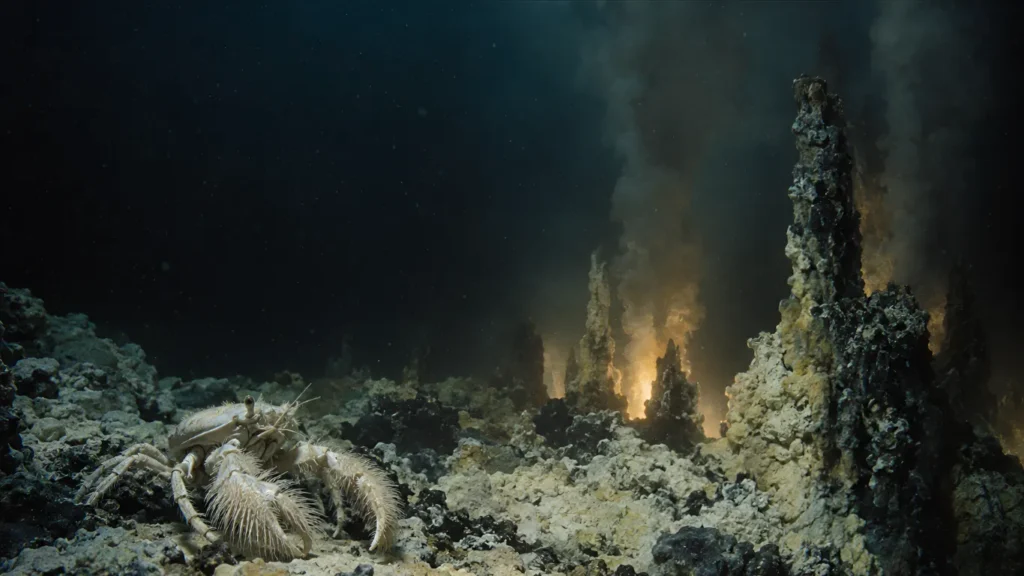
The most influential specific proposal came from Günter Wächtershäuser in the late 1980s and early 1990s. He developed the iron-sulfur world hypothesis. According to this model, the earliest metabolic chemistry occurred on the surfaces of iron- and nickel-sulfide minerals near hydrothermal vents. A key energy-releasing reaction is the conversion of iron sulfide and hydrogen sulfide into pyrite.
In this environment, the argument goes, iron-sulfide minerals could have acted as primitive catalysts. A simple reaction pathway might have converted carbon dioxide and hydrogen gas into more complex carbon-containing compounds such as acetate and pyruvate, releasing energy in the process. Hydrogen provided the energy; metallic minerals kept the cycle running. Once a primitive cycle was established, it could have begun producing increasingly complex compounds, building out into more elaborate enzymatic loops long before any genetic mechanism of inheritance existed.
What the experiments show
A major strength of the metabolism-first view is the growing body of laboratory evidence that core metabolic pathways can run without enzymes under conditions plausible for the early Earth.
Researchers have shown that metal ions abundant in ancient oceans and sediments — especially ferrous iron (Fe(II)) — can catalyze many steps of glycolysis, the pentose-phosphate pathway, parts of the citric acid (Krebs) cycle, and related reactions. Versions of these pathways produce sugars, ketoacids, and precursors of amino acids and nucleotides. Some cycles can be driven by simple inorganic oxidants or reductants. Recent studies continue to demonstrate non-enzymatic routes to carbon fixation and the synthesis of metabolic intermediates under milder conditions than those once thought necessary.
These results suggest that “proto-metabolism” is not an appeal to magic. Plausible geochemical settings can spontaneously generate reaction networks that look strikingly similar to the conserved core of modern biochemistry.
Strengths, Challenges, and Current Status
The metabolism-first hypothesis has gained experimental traction, but it faces real problems. One long-standing criticism is that without a genetic encoding system, a prebiotic metabolic network would have limited ability to evolve adaptively—it could persist, but could it improve? A 2026 paper in the Journal of the Royal Society Interface addressed a related concern: that side reactions would poison autocatalytic cycles. Using realistic assumptions (reversible reactions in open environments), the authors showed that side reactions are not always lethal and can sometimes even help the system persist, concluding that side reactions do not provide sufficient grounds for rejecting metabolism-first models.
Conclusion
The metabolism-first theory does not claim to have solved the origin of life. It does, however, offer a coherent, chemically grounded framework in which life’s most fundamental processes — the continuous flow of energy and the building of complexity — could have begun as geochemistry and gradually become biochemistry. In this view, life is less a sudden invention of genes than the gradual takeover of planetary chemistry by self-sustaining reaction networks that eventually learned to remember and improve themselves.
Sources:
How a Metabolic Spark Could Have Jump-Started Life – Quantamagzine
‘Impossible’ chemistry may reveal origins of life on Earth – NATIONAL GEOGRAPHIC
Metabolism may be older than life itself and start spontaneously – Newscientist