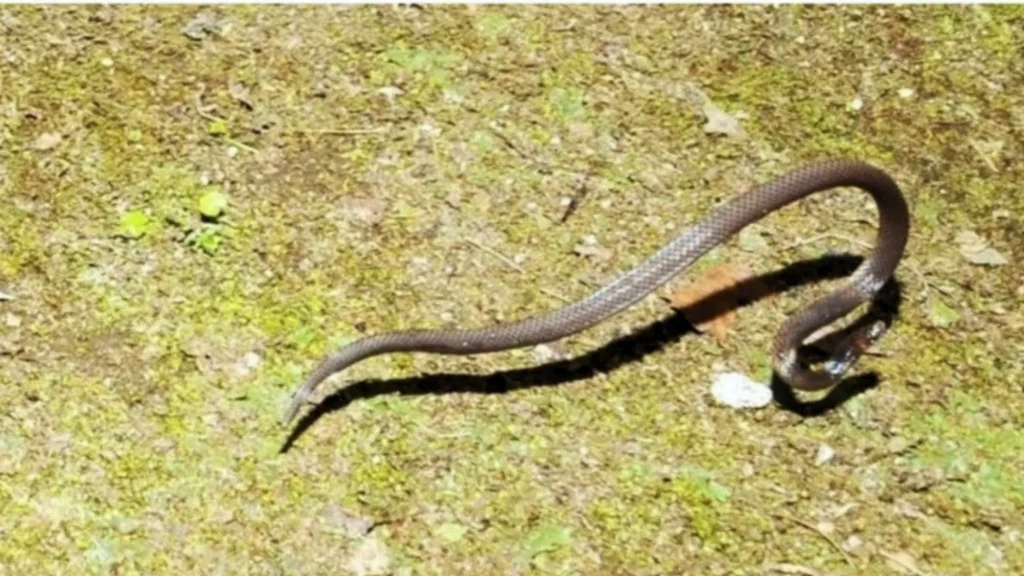
Most snakes defend themselves by biting, flattening their hoods, rattling their tails, or simply slithering rapidly into the underbrush. Yet deep in the rainforests of Southeast Asia, a group of tiny snakes in the genus Pseudorabdion cartwheel at high speed to escape predators. For decades, this sounded like folklore, but it has now been filmed, measured, and published.
This rare form of locomotion was first formally documented in 2023 and analysed in detail in a 2026 study. These dwarf reed snakes—slender, nocturnal animals typically 11–28 cm long—use coordinated body and tail movements to roll forward rapidly, reaching speeds of 1.7 to 3.7 meters per second (roughly 6–13 km/h), about four times faster than ordinary slithering. That is approximately four times faster than the peak speed the same snakes achieved through conventional lateral undulation.
From First Observation to Scientific Discovery
Anecdotal reports of rolling dwarf reed snakes existed for years, but the behaviour was first scientifically described in 2023. Researchers led by Evan Seng Huat Quah observed a cartwheel snake on a mountain road in Malaysia. When approached, the snake coiled and launched into repeated cartwheels, covering about 1.5 meters in under five seconds, both downhill and on flat ground. The team published photographs and a detailed description in the journal Biotropica, marking the first formal record of active cartwheeling in any snake.
In 2026, a team led by Yosuke Kojima of Toho University expanded the work. After collecting specimens in Malaysia’s Kubah National Park (11 P. saravacense, one P. collaris, and one P. longiceps), they filmed the snakes on a laboratory track using cameras from above and the side. All 13 Pseudorabdion individuals cartwheeled when gently stimulated. For comparison, six related Calamaria reed snakes only slithered normally. The results appeared in Current Biology on 19 October 2026. However, the sample was small, particularly for P. collaris and P. longiceps, which were represented by only one individual each. Further observations will be needed to establish how widespread this behaviour is within the genus.
How a snake cartwheels
The 2023 paper established that the snakes cartwheel. Unlike animals such as pangolins, wheel spiders, or pebble toads—which curl into passive balls and rely on gravity to tumble downhill. Dwarf reed snakes generate active, powered propulsion even on completely flat ground.
The observation was led by ecologist Yosuke Kojima of Toho University in Japan: the team built a 2.2-meter track lined with high-speed cameras and gently tapped the snakes to startle them into rolling. High-speed video revealed a precise, repeatable sequence rather than simple tumbling:
- The snake curls its body into a tight C-shape (or sometimes an S-shape in earlier observations), lifts its head off the ground, and orients it toward the intended direction of travel.
- It forcefully straightens and whips its tail backward, briefly lifting much of its body into the air.
- While airborne or nearly so, the snake swings its tail forward and over its head, forming an arch.
- The tail (or a section of body) lands on the ground ahead of or beside the head—alternating left or right sides in successive rolls—completing one rotation and setting up the next.
The head remains relatively stable and forward-facing even as the body rotates at speed. The tail provides the primary propulsive force, allowing the snake to convert muscular energy into forward rolling momentum. The motion is active and powered, not passive rolling under gravity (though slopes amplify speed).
Why Cartwheel Instead of Slither?
Nobody has watched a cartwheeling snake escape a real predator in a controlled study, so the “why” rests on reasonable inference. The leading hypothesis is that cartwheeling serves as a sudden, disorienting escape. The frantic, unpredictable motion may startle a predator long enough for the snake to reach cover. There is also a secondary possibility: because the rolling motion puts less of the snake’s body in contact with the ground than slithering does, it may leave a weaker scent trail for tracking predators to follow. This idea remains unproven.
The trade-off is energy. Cartwheeling is metabolically expensive. “This behaviour is surprising as it is not a typical form of movement that we associate with snakes,” Quah told IFLScience. “Cartwheeling is also probably very metabolically taxing for the snake as they cannot sustain this behaviour repeatedly or over long distances. It is a defence mechanism employed only under extreme duress”. The snakes can use downhill slopes to extend their rolls, but on flat ground the burst is short-lived.
What we still don’t know
Several questions remain unanswered. Cartwheeling is extremely rare among vertebrates. A few animals (certain pangolins, some toads) can roll, but active, powered cartwheeling by a limbless reptile was previously unknown. Researchers have not determined whether the cartwheeling species possess special anatomical features that enable the manoeuvre, or whether it is purely a matter of coordinated muscle control. The discovery adds to the known repertoire of snake locomotion, which already includes sidewinding, concertina movement, rectilinear crawling, jumping, and even gliding in some species.
Conclusion
These tiny snakes have turned their limbless bodies into temporary rolling machines. Through coordinated movements of their posterior body, they can propel themselves forward while keeping their heads relatively stable and facing the direction of travel. What looks like uncontrolled tumbling is actually a carefully coordinated form of locomotion.
First documented in 2023 and later examined using high-speed video, this unusual behaviour reveals just how diverse snake movement can be. Scientists have now measured its speed and uncovered the mechanics behind it. Sometimes, the fastest way for a snake to escape is not to slither, but to roll.
Sources:
[How snakes roll at high speed – News From Toho](https://global.toho-u.ac.jp/research/pr-1658/?)
Locomotor kinematics and head stabilization in rolling snakes – ScienceDirect.com
Snake does cartwheel to escape danger – www.science.org
Cartwheeling Snakes May Be Trying To Bamboozle Predators – IFLSCIENCE