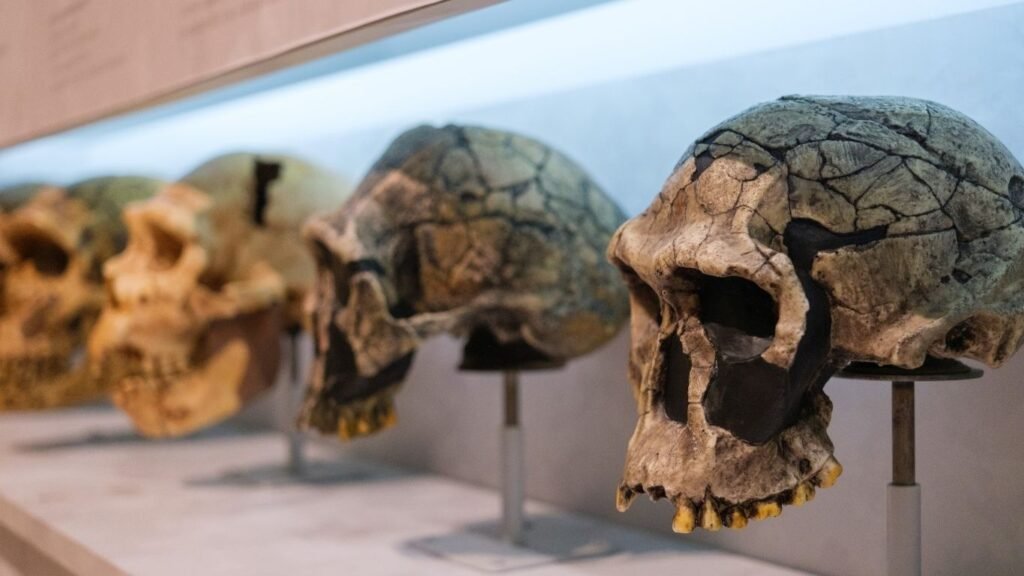
The title “oldest fossils of Homo sapiens” is not a fixed claim. It is a contested scientific claim that has shifted dramatically over the past two decades. The oldest known fossils of Homo sapiens (anatomically modern humans) come from the site of Jebel Irhoud in Morocco. It date backs to approximately 315,000 years ago. These remains, first recovered in the 1960s and rigorously re-excavated and dated in the 2010s. It pushes the fossil evidence for our species back by roughly 100,000 years. From the previously accepted East African specimens and support a pan-African origin for Homo sapiens.
Jebel Irhoud: The Current Record Holders
The oldest securely dated fossils attributed to Homo sapiens are a collection of skulls, teeth, and long bones representing at least five individuals. From the site of Jebel Irhoud, roughly 100 kilometres west of Marrakesh. The site was originally a cave that was partially destroyed by barite mining. Additional fossils, including a mandible (Irhoud 3), were found in subsequent years. Early interpretations classified them as North African Neanderthals or “African Neanderthals” and assigned them a relatively recent age of around 40,000 years.
For decades after their discovery in the 1960s, these fossils were an anomaly. The breakthrough came from dating the tools themselves. Many of the flints had been heated by ancient fires, allowing researchers to apply thermoluminescence dating. The results placed the fossils and their associated tools at approximately 315,000 ± 34 thousand years ago, with a conservative estimate of about 300,000 years.
The morphology is critical to the claim. The Jebel Irhoud faces are “almost indistinguishable” from those of living humans. But the braincase is elongated rather than globular. This suggests that the modern human facial blueprint evolved before the distinctive round skull shape of our species. A finding that complicates any simple narrative of a single, sudden origin.
The Previous Record-Holders: Omo Kibish and Herto, Ethiopia
Omo Kibish (Omo I and Omo II)
Discovered in 1967 by a team led by Richard Leakey in the Kibish Formation of the Lower Omo Valley. These include a relatively complete and modern-looking skeleton (Omo I, with a chin and other derived features) and a more robust calvaria (Omo II). Argon-argon dating of underlying tuffs initially placed them at approximately 195 ± 5 thousand years (McDougall et al., 2005). A 2022 study correlating a volcanic ash layer above the fossils with a dated eruption of the Shala volcano. This revised the minimum age upward to about 233 ± 22 thousand years. Even with this older estimate, Omo remains younger than Jebel Irhoud.
Herto (Homo sapiens idaltu)
Three partial skulls from the Middle Awash region of Ethiopia, dated to roughly 160,000–154,000 years ago, show a combination of modern and robust features and were once considered the oldest clear modern humans.
Florisbad, South Africa
The Florisbad cranium, discovered in South Africa, is often discussed as a possible early Homo sapiens fossil. It has been dated to approximately 259,000 years ago, but its classification remains debated. Its anatomy includes a mixture of modern and more archaic features, and questions remain about whether the dated tooth and cranium belong to the same individual. For these reasons, Florisbad is an important early human fossil, but it is not as securely classified as the Jebel Irhoud remains.
What “Oldest” Actually Means
The shifting record reflects a deeper methodological problem. Fossil ages are only as good as the stratigraphy and the dating methods applied to the layers around them. Direct dating of the fossils themselves is often impossible or unreliable, so researchers date volcanic ash, heated flint, or associated animal teeth. Each method has error margins, and each site has stratigraphic complexities—contaminated ash crystals, intrusive burials, uncertain correlations between distant tuff layers.
Conclusion
The Fossils from different parts of Africa preserve a mixture of modern and archaic features, supporting the possibility that our species evolved through a gradual process involving populations spread across the continent. The extent of their connectivity and how this process unfolded remain active areas of research. The oldest fossils are not a starting gun. They are snapshots of a process.
The fossils from Jebel Irhoud, Morocco—dated to roughly 315,000 years ago—currently hold the record as the oldest Homo sapiens remains. They reveal that the evolutionary roots of our species are deeper and more geographically widespread across Africa than scientists once believed.