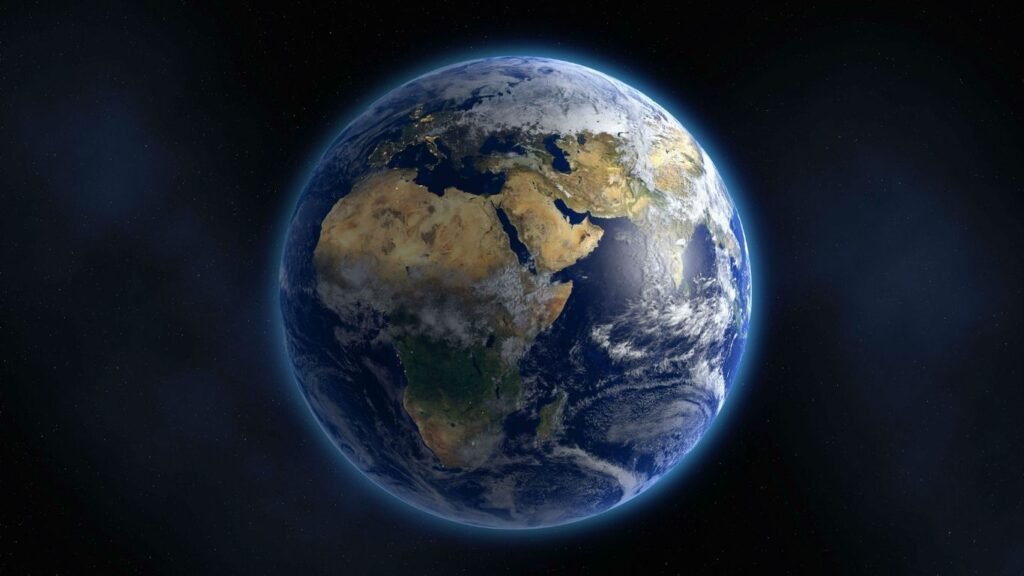
Planet Earth, the beautiful blue dot we call our home, has been around for thousands of years, but have you ever wondered how old it really is? How many years did it take the Earth to become as we see it now? How do we know that?
The short answer is, Earth is about 4.54 billion years old. Scientists determined this age primarily through radiometric dating of meteorites and the oldest terrestrial minerals, building on earlier relative geological dating and the discovery of radioactivity. This figure, refined to 4.54 ± 0.05 billion years, represents the time of Earth’s accretion and differentiation in the early Solar System. These methods also helped scientists determine how far back life on Earth dates.
Deep time: from thousands of years to millions
Many have tried to answer the question of how old the Earth is. Before modern methods, ages varied widely. In 1650, Archbishop James Ussher calculated a biblical chronology placing Earth’s creation at 4004 BCE (about 6,000 years ago).
In the 19th century, physicist Lord Kelvin estimated 20–100 million years based on the cooling of a once-molten Earth, assuming no internal heat sources. Geologists, however, argued for far greater ages. James Hutton’s uniformitarianism (late 18th century) and Charles Lyell’s work showed that gradual processes like erosion and sedimentation required immense time.
Stratigraphy (rock layering), the principle of superposition, and the consistent order of fossils (faunal succession) established a relative geological timescale with the Precambrian vastly older than the fossil-rich Phanerozoic, but without absolute numbers.
Radioactivity gives geology a clock
How does radioactive dating work?
Some atoms are unstable and slowly change into other atoms over time. This process is called radioactive decay.
Scientists know how quickly certain radioactive atoms decay. For example, uranium-238 takes about 4.47 billion years for half of a given amount to decay into lead-206.
Think of it as a natural clock inside a mineral. By measuring how much uranium remains and how much lead has formed, scientists can estimate when that mineral crystallized.
One mineral is especially useful: zircon. When zircon crystals form, they readily take in uranium but generally exclude lead. Scientists can therefore use the uranium and lead inside them to estimate their age. They also compare different uranium-lead dating systems to check whether the results agree and whether the mineral may have been disturbed later.
The age of the Earth: 4.54 billion years
How did scientists determine Earth’s age?
A major breakthrough came in 1956, when American geochemist Clair Patterson used precise lead-isotope measurements to estimate the age of Earth and meteorites.
Meteorites are valuable because they preserve material left over from the formation of the Solar System. By measuring the proportions of different lead isotopes in meteorites, Patterson calculated an age of approximately 4.55 billion years.
Later research refined the estimate. Today, scientists place Earth’s age at about 4.54 billion years.
This result is supported by other evidence. Tiny zircon crystals found in Western Australia are about 4.4 billion years old, showing that some solid material from early Earth has survived. Ancient lunar rocks and meteorites provide additional clues about the early history of the Solar System.
Conclusion
Scientists didn’t discover Earth’s age through a single experiment. They combined evidence from ancient minerals, meteorites, and radioactive decay to reconstruct the early history of our planet.
These independent measurements point to the same conclusion: Earth formed about 4.54 billion years ago. Although our planet’s surface has changed dramatically over time, tiny mineral crystals and meteorites have preserved clues about its ancient past.
What once seemed impossible to know—the age of our planet—became measurable through the discovery of radioactivity and the development of precise scientific techniques.