Yes, Homo erectus is traditionally recognized as the first human species to leave Africa. For decades it was the textbook answer: Homo erectus left Africa about 1.8 million years ago and spread across Eurasia. This dispersal, often called “Out of Africa I,” began around 1.8–2.0 million years ago. It represents one of the most important events in human evolutionary history. However, ongoing archaeological breakthroughs. The most notably one discovery of 2.1-million-year-old stone tools in East Asia. This have sparked a major debate in paleoanthropology over whether an even earlier hominin preceded Homo erectus out of Africa.
These discoveries raise an important question: Was Homo erectus really the first human species to leave Africa, or did an earlier, less well-known hominin make the journey?
Who was Homo Erectus?
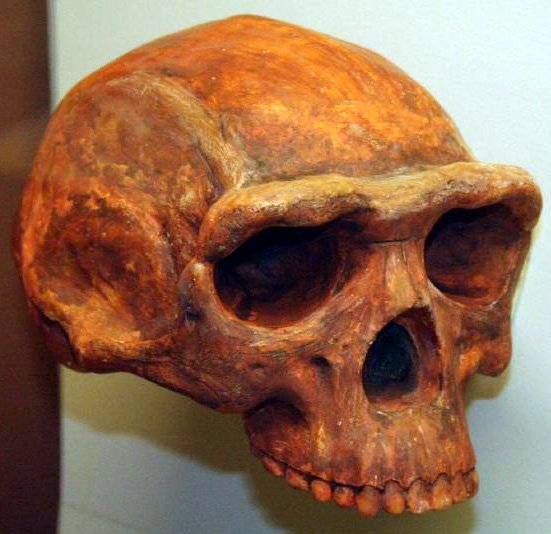
Homo erectus (“upright man”) appeared in Africa around 2 million years ago. One of the earliest fossils attributed to Homo erectus is DNH 134, a cranium discovered at Drimolen in South Africa. It was dated to approximately 2.04 million years ago. Its classification has strengthened the possibility that Homo erectus appeared earlier than previously thought. Although its precise taxonomic status remains debated. It has a body plan much closer to modern humans than to earlier australopithecines or Homo habilis. It has longer legs, shorter arms, and fully bipedal locomotion suited to endurance walking and running. A larger brain (typically 600–1,100 cm³, increasing over time) than earlier Homo. It used more advanced stone tools (initially Oldowan, later Acheulean handaxes). Possible early control of fire and a broader diet that included more meat.
Many paleoanthropologists distinguish an African form sometimes called Homo ergaster from the classic Asian Homo erectus. But most treat them as a single, highly variable species or a closely related complex. Homo erectus persisted for nearly 2 million years—far longer than any other human species. It occupied a vast range from Africa through the Caucasus, East Asia, and Southeast Asia (including Java).
The Classic Evidence: Dmanisi and Beyond
The classic narrative held that Homo erectus—with its larger body, bigger brain, and more sophisticated toolkit—was uniquely equipped to expand out of Africa. The strongest evidence that Homo erectus was the first to leave Africa comes from the site of Dmanisi in the Republic of Georgia. Excavations there have yielded five well-preserved skulls, mandibles, and postcranial bones of at least five individuals, along with simple stone tools and a rich fauna. The Dmanisi fossils are generally classified as early Homo erectus or Homo erectus sensu lato. Although some researchers regard them as a distinct or more primitive form of early Homo. Their small brains and relatively primitive anatomy demonstrate that the first hominins to leave Africa. It did not necessarily possess all the characteristics of later Homo erectus.
The Chinese Challenge: Tools Older Than Homo erectus
The most direct challenge to the H. erectus-first model comes not from fossils but from stone tools. At the site of Shangchen in China’s Loess Plateau, researchers documented 17 artifact layers spanning a remarkably long sequence. The oldest of these layers dates to approximately 2.12 million years ago. This is roughly 250,000 to 300,000 years older than the Dmanisi fossils.
The tools are simple flakes and cores, but they bear clear signs of intentional flaking and use. No hominin fossils have been found at the site, so the identity of the toolmakers remains unknown. If the archaeological interpretation and dating of Shangchen are correct, hominins were present in East Asia approximately 2.12 million years ago. This would imply that hominins reached Asia earlier than the earliest widely accepted evidence of Homo erectus outside Africa. However, the origin of the tools is still debated.
Possible Earlier Evidence and Ongoing Debates
If the Shangchen toolmakers were not H. erectus, what were they? The honest answer is that we do not know. Several possibilities exist. They may have been a more primitive species of Homo—perhaps something akin to Homo habilis or a related early hominin—that dispersed before the evolution of H. erectus‘s distinctive anatomy. Few researchers have even suggested that H. erectus may have evolved in Asia from these earlier migrants and then migrated back into Africa, reversing the traditional direction of the story.
Additional claims of even earlier tools (for example, from the Zarqa Valley in Jordan, potentially ~2.5–2.0 Ma) exist but are more controversial and not yet widely accepted. No undisputed skeletal remains of any hominin older than the Dmanisi fossils have been found outside Africa. Therefore, while Shangchen and similar sites open the possibility of pre-erectus dispersals, they do not overturn the conclusion that Homo erectus was responsible for the first major, sustained colonization of Eurasia.
Conclusion
The fossil record from Dmanisi (~1.8 Ma) and subsequent Asian sites establishes Homo erectus as the first human species to leave Africa successfully and on a large scale. Claims of slightly earlier stone tools in China (Shangchen, ~2.1 Ma) suggest that limited dispersals by closely related early Homo may have occurred. These claims remain fossil-free and therefore less conclusive. For now, the weight of evidence—skeletal remains, dating, and archaeological context—confirms that Homo erectus was the pioneer of the first great human expansion out of Africa, setting the stage for all later human dispersals, including those of Neanderthals, Denisovans, and eventually Homo sapiens.