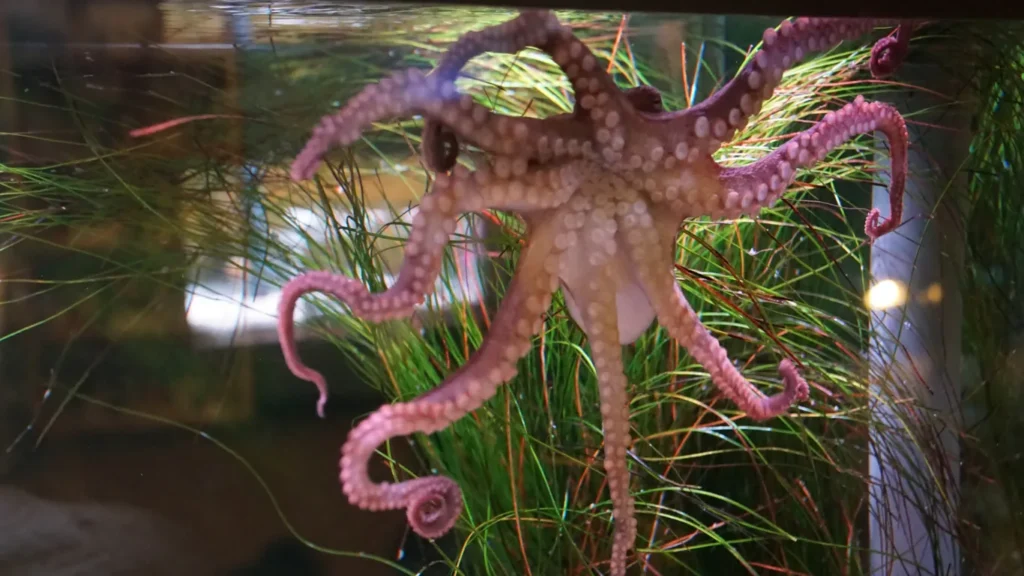
A fully-grown octopus can slip through an opening that looks far too small for it. There are many aquarium keepers have the escape stories to prove it. As long as an opening is a little wider than that single chitinous beak, a soft-bodied octopus can flatten, elongate, and stream its muscles and organs through tight crevices that would stop a vertebrate of the same size dead in its tracks.
A simple answer is: An octopus has almost no hard parts. Its body is mostly muscle, and its muscles are arranged so that it can change shape almost at will. The one rigid structure in its body is its beak, and that sets the practical limit on what it can fit through.
Anatomy That Makes Extreme Compression Possible
Octopuses are invertebrates with a soft, boneless body. An octopus’s arms are muscular hydrostats: structures made almost entirely of muscle, without bones or joints. By contracting different groups of muscle fibres, an arm can extend, shorten, bend, or stiffen while maintaining roughly the same volume. The mantle is also highly flexible and muscular, allowing the animal to change the shape of its body as it moves through narrow spaces.
The arms themselves are especially versatile. Each is packed with longitudinal, transverse, and oblique muscle fibers. This arrangement lets an octopus extend an arm, bend it in any direction, shorten it, or stiffen it for pushing or pulling. Suckers provide grip and sensory feedback, helping the animal explore and anchor itself during a squeeze.
Octopuses also have a highly distributed nervous system. A large proportion of its neurons are located in its arms rather than in its central brain. This allows the arms to process sensory information and coordinate many movements locally, although the brain still plays an important role in controlling overall behaviour.
The beak, located in the center of the arms where they meet the head, is the hardest part of the body and has long been considered the primary size limit. Recent research suggests the stiff cartilage around the brain (approximated by the distance between the eyes) and the thickness of the arm bases near the body may also constrain the smallest passable opening.
How Do Octopuses Squeeze: An Experiment
A 2026 study published in the Journal of Experimental Biology by Wenci Xin. He and his colleagues filmed three common octopuses and four Mayan octopuses escaping through carefully sized holes in acrylic partitions. The animals used consistent, size-dependent strategies.
When the hole was wider than the distance between the octopus’s eyes, they typically followed a three-step sequence:
- Probe: It explored the hole with its arms, assessing the situation.
- Thread: It pushed one arm through first—often one of the two front-left arms—followed by up to five more.
- Push and pull: The arms that had already passed through reached back, gripped the partition with their suckers, stiffened, and pushed against the box while pulling the remaining arms, head, and mantle through. The whole operation took about 20 seconds
When the hole was narrower than the inter-eye distance, the animals switched to a four-step strategy. After probing and shifting some arms through, they pulled the remaining arms through first, then carefully compressed and pulled the head and mantle through separately. This extra step appears to reduce the bulk that must pass at any one moment and allows finer control over the more delicate, organ-filled mantle.
The whole process can take only seconds for larger openings and up to about 20 seconds for tighter ones. The octopuses do not always accurately judge whether they will fit beforehand; they often attempt a gap and only abandon it if the arms cannot advance.
Are All Octopuses Are Equally Bold
The answer is no. The Mayan octopuses are a bit different when confronted with the tighter hole. They don’t even try. They sat in the corner of the box and never even explored the aperture with their arms. When given a choice between a small and large hole, they would briefly investigate the small one before abandoning it for the easier exit.
The researchers believe this behavioural difference may reflect their ecology. Mayan octopuses live in sandy, rocky areas where they may shelter under rocks but don’t routinely need to cram through tight openings. However, the experiment does not establish why Mayan octopuses avoid the tighter openings. More research is needed to determine whether this is a species-wide behavioural difference or a response influenced by other factors.
Limits and Open Questions
Even an octopus has limits. The beak and braincase cannot compress, and the combined bulk of the arm bases near the body may create an additional constraint. Species differences also appear, such as between common octopuses and Mayan octopuses.
Researchers are still refining exactly what sets the absolute minimum diameter and how the nervous system coordinates the complex sequence of arm and body movements. The findings are already inspiring soft-robotics engineers who want machines that can navigate tight spaces for search-and-rescue or inspection tasks.
Why Learning Octopus Biology Matters
This study isn’t just about satisfying curiosity. In the wild, the ability to slip through tiny crevices is a powerful survival tool. Octopuses use it to escape predators, hide in narrow rock cracks or discarded shells, and reach prey in otherwise inaccessible spots. Their soft bodies also allow them to change shape dramatically for camouflage and locomotion.
Octopus anatomy has become a model for soft robotics, where engineers build machines from flexible materials that can reach into tight spaces, grip irregular objects, and bend without joints. It’s a nice example of evolution solving problems by losing parts, while engineers solve them by adding them. An octopus-inspired robot with distributed arms and a compressible body could offer a different, more capable architecture.
Conclusion
An octopus does not “force” its way through a tiny opening so much as reconfigure its entire boneless body—arm by arm, then mantle—until it flows through. It is a staged, controlled, size-sensitive procedure that protects the animal’s most vulnerable parts by moving them last and with the most care. The combination of muscular hydrostats, decentralized arm control, and flexible behavioural strategies makes these animals among the most effective soft-bodied escape artists in the animal kingdom.
The next time you see a video of an octopus vanishing through a gap that looks impossibly small, you’ll know there’s a three- or four-step plan behind the escape. And a robot engineer somewhere is taking notes.
Sources:
How octopuses squeeze through tiny openings – ScienceNews
Octopuses Can Squeeze Through Tiny Gaps – discovermagzine.com
These are the weird and wonderful reasons octopuses – National Geographic