At some point in their life many people have looked at the sky and asked why the sky is clear blue. Turns out many people around the world have wondered the same, and a lot of them were scientists who wanted to know the answer to this question. After years of observation and research, a clear theory emerged of how light scatters when it collides with tiny particles in the atmosphere; a physicist, Lord Rayleigh, first described this in 1871. The blue colour of the sky is connected with that theory.
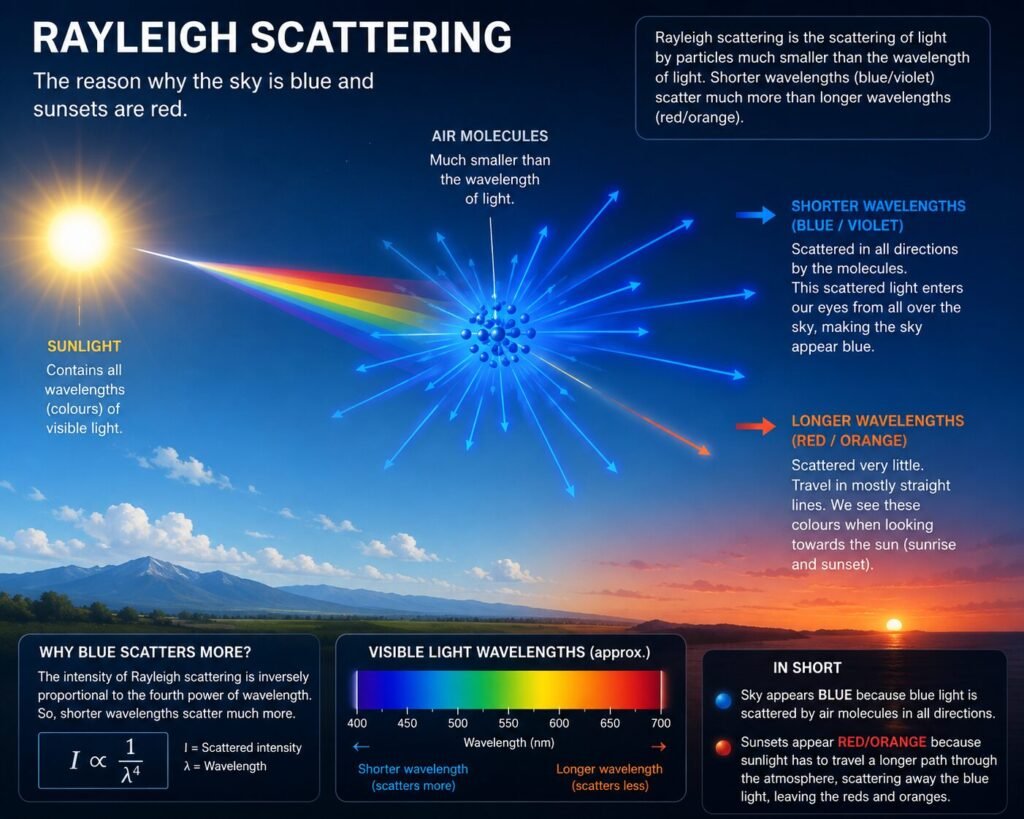
Sunlight appears white, but it consists of all the colours of the rainbow from red to blue and violet, each with different wavelengths. Red has the longest wavelength, and blue and violet have the shortest wavelengths.
How does it work?
When sunlight enters the atmosphere, it collides with molecules and particles in our atmosphere, mainly Nitrogen and Oxygen, and scatters; blue and violet due to their short wavelengths scatter the most in the atmosphere compared to red.
Why do we see the sky blue, not violet? The answer is simple: the sun emits less violet light and more blue light, and the human eye is naturally more sensitive to blue light.
During sunset or sunrise, why does the sky look red and orange? During sunset or sunrise, the sun is at a lower angle, and the path length increases in the atmosphere, leading to more scattering of the shorter wavelengths. As a result, longer wavelengths such as red and orange that don’t scatter much reach first, and we see a red or orange shade in the sky.
The colour of the sky can also vary due to atmospheric conditions and the presence of particles like dust and pollutants. These variations may lead to vibrant sunsets, hazy skies, or even the deep blue hues seen in certain regions.
Conclusion
So, the next time you see the sky, remember it’s blue because Earth’s atmosphere scatters the sunlight. Other Planets have their own sky colours due to their atmospheric conditions; Mars has a yellowish-brown day and a blue sunset due to heavy iron-oxide (rust) particles, and a very thin atmosphere. Likewise, Venus orange/yellowish colour on its surface due to its very dense atmosphere with high carbon dioxide and sulfuric acid-rich clouds. Earth’s blue colour is mainly due to nitrogen and oxygen in its atmosphere that scatter the blue light the most.