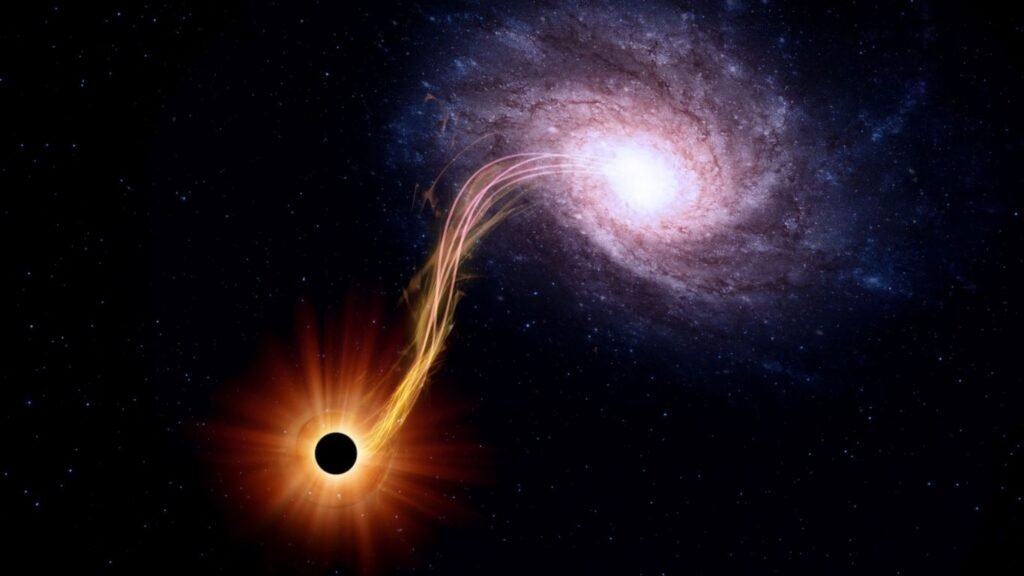
In one sentence, the answer is no: Black holes are not cosmic vacuum cleaners.
One of the most persistent misconceptions in popular science is the idea that black holes act like giant “cosmic vacuum cleaners. Wandering through the universe and indiscriminately sucking in everything around them. In reality, black holes obey the same laws of gravity as every other massive object. From a safe distance, their gravitational influence is no stronger or more “greedy” than that of a star or planet of the same mass.
The Core Misconception: Gravity Is Not Suction
The idea that black holes suck everything in stems from a misunderstanding of how gravity works. Gravity is an attractive force that curves spacetime, but it does not create a “suction” effect. The gravitational field of a black hole is determined entirely by its mass. Far outside the event horizon, the gravitational field is no different from that of any other object of the same mass.
A clear thought experiment illustrates this. If the Sun were suddenly replaced by a black hole of exactly the same mass, Earth’s orbit would continue almost unchanged. We would freeze in the dark without sunlight, but we would not spiral inward. The same holds for the other planets. What changes is the size of the object. A solar-mass black hole has an event horizon only about 3 km (roughly 2 miles) across, while the Sun’s radius is about 700,000 km. You can therefore get much closer to the black hole’s mass before encountering the point of no return.
Why the Myth Persists
The vacuum cleaner analogy is intuitive because black holes are the densest concentrations of mass in the universe. And their event horizons represent a point of no return. Popular culture and even some educational materials have reinforced this image. NASA itself has acknowledged that television and movies have portrayed black holes as “cosmic vacuum cleaners sucking up everything in sight,”. This depiction is a contrary to the actual physics.
The Messy Reality of Black Hole Feeding
When black holes accumulate matter, they do not simply pull everything straight into themselves. Matter approaching a black hole usually carries angular momentum, causing it to form a rotating structure called an accretion disk.
As material moves through the disk, interactions involving turbulence and magnetic fields transfer angular momentum between different regions. This allows some matter to gradually spiral inward. During this process, gravitational energy is converted into heat, making the surrounding gas extremely hot and causing it to emit radiation, including X-rays.
Interestingly, not all the material in an accretion disk ends up inside the black hole. Magnetic fields and radiation can help drive powerful winds and jets that carry gas and energy back into space.
Another important concept is the Eddington limit. It describes the balance between the inward pull of gravity and the outward pressure produced by radiation from infalling material. It provides a useful estimate of how quickly a black hole can accrete matter under certain conditions. Although some black holes can exceed this limit temporarily or under special circumstances.
Stable Orbits and Galactic Safety
Most of the matter in the universe is in stable orbits around gravitational centres, not on it’s way to a black hole. Stars in the Milky Way, including our Sun, have orbited the supermassive black hole at the galactic center for billions of years without being sucked in. The same physics that keeps planets in orbit around the Sun applies here as well. As long as a star retains its orbital angular momentum, it will not fall into the central black hole.
At the centre of the Milky Way lies Sagittarius A*, a supermassive black hole with roughly four million times the mass of the Sun. Several stars orbit relatively close to it, following paths governed by its powerful gravity. They do not automatically spiral into it because their orbital motion keeps them moving around the black hole rather than directly towards it.
However, these orbits are not necessarily permanent. Gravitational interactions with other objects can change a star’s orbit. And objects that pass sufficiently close to a black hole can be captured or torn apart by tidal forces.
What Black Holes Actually Do
Black holes grow through two primary channels. Acretion of matter that happens to cross the event horizon, and mergers with other black holes. Accretion is most efficient when a black hole has a binary companion. A star close enough for material transfer or when it resides in a dense environment like a galactic center where gas and stars are plentiful. Even then, the process is gradual and limited by the physics of angular momentum and radiation pressure .
Black holes also evaporate, albeit extremely slowly. Through Hawking radiation, a quantum effect at the event horizon, black holes lose mass over time. For stellar-mass black holes, this process is negligible on any practical timescale, but it demonstrates that black holes are not permanent, all-consuming sinks.
Conclusion
Black holes’ gravitational influence is determined by their mass, and objects can orbit them just as they orbit other massive bodies. They curve spacetime around them exactly as their mass dictates, and objects that come close enough—within the event horizon—cannot escape. But at any distance beyond that horizon, their influence is no different from that of any other mass. The universe is not being drained into black holes; it is orbiting, falling, and occasionally being torn apart near these fascinating objects, but the vast majority of matter remains safely outside their reach.
The cosmic vacuum cleaner is a myth. The real picture is stranger and more interesting: black holes are the messiest, most selective eaters in the universe.