The answer is NO, the North Star does not stay fixed in the sky forever.
For centuries, people have used Polaris (the current North Star) to find north and navigate at night. It appears almost fixed in the sky, but that alignment isn’t permanent. People across many eras have believed that the North Star, Polaris, always stays in one place, but modern astronomy says otherwise. It appears nearly stationary at night because Earth’s rotational axis currently points very close to it, but that alignment is temporary. Over millennia, the axis slowly wobbles, so different stars take turns as the pole star.
Why Polaris looks fixed right now
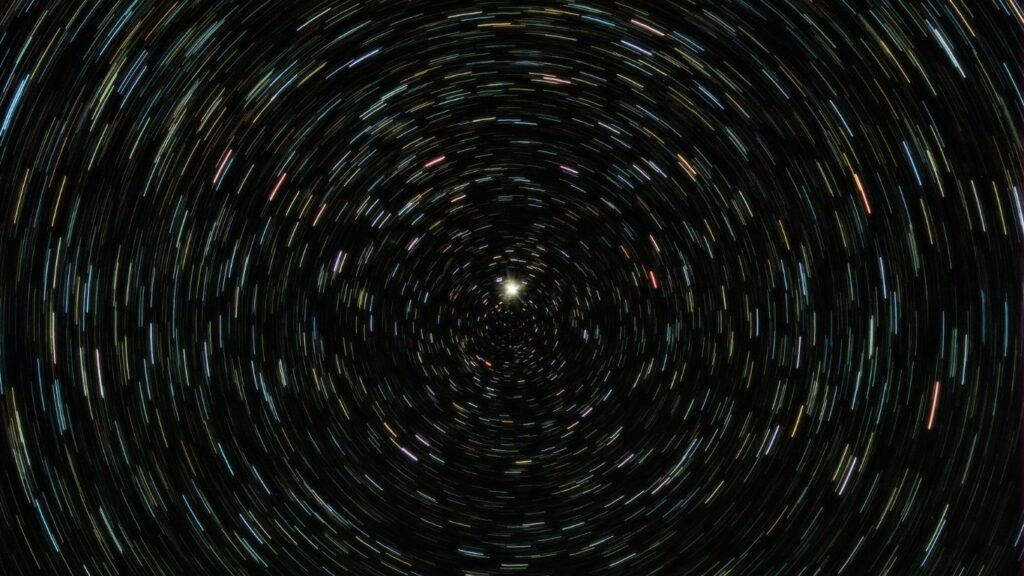
A “North Star” is simply whatever visible star happens to align closely with Earth’s rotational axis extended straight out into space (the North Celestial Pole). Earth spins once per day on an axis tilted about 23.4° relative to its orbital plane. The northern end of that axis projects onto the sky at the North Celestial Pole. Stars appear to circle that point overnight.
Polaris (Alpha Ursae Minoris) lies only a short distance from the pole. As of 2026 it is approximately 0.62° away (about 1.2 full-Moon diameters). That offset means it traces a tiny daily circle roughly 1.2–1.3° in diameter—small enough that the naked eye perceives it as fixed while other stars sweep large arcs.
The north celestial pole is still drifting closer to Polaris. Polaris will appear closest to the north celestial pole. of about 0.45–0.46° (roughly 27–28 arcminutes) around the year 2100–2102. After that, the pole will slowly move away again.
The real reason (What is axial precession)
Earth is not a perfect sphere; it bulges at the equator. The gravitational pull of the Sun and Moon on that bulge creates a torque. Instead of tipping the axis over, the torque causes it to precess—like the slow wobble of a spinning top.
One complete precession cycle takes roughly 25,800–26,000 years (modern estimates cluster near 25,772 years). During that time the north celestial pole traces a circle about 47° in diameter on the sky (twice the axial tilt of ~23.4°), centered on the north ecliptic pole.
As the pole moves, whichever relatively bright star happens to lie nearest becomes the “North Star” of that era.
The Past and Future North Stars
Because of this precessional movement, different stars take turns acting as the marker of the north celestial pole throughout history:
- Thuban (in Draco) was the pole star around 2700 BCE, when the Egyptian pyramids were being built.
- Polaris has been the pole star for roughly the last thousand years or so, and it will remain a good one for a few more centuries.
- Gamma Cephei (Errai) will take over around 4000 CE.
- Vega, one of the brightest stars in the sky, will be the pole star around 13,700 CE.
Other small effects
Stars also have their own slow motion through space (proper motion), and Polaris is a pulsating variable star whose brightness changes slightly. Neither matters much compared with precession.
So the North Star is more of a title that passes between stars over millennia than a permanent fixture. Only the Northern Hemisphere has one. The Southern Hemisphere has a south celestial pole too, but it currently lacks a bright star close enough to mark it as conveniently as Polaris marks the north.
Conclusion
Polaris is an excellent North Star for our era—bright enough, close enough, and easy to find via the Big Dipper’s pointer stars—but it is not permanent. The “fixed” quality people have celebrated for centuries is an accident of timing in Earth’s 26,000-year precessional cycle. In a few thousand years future navigators (or their future equivalents) will look to other stars, and eventually the sky’s northern hub will move on again.