NASA
When people ask, “Is the far side of the Moon always dark?” The clear answer is a big NO.
The moon doesn’t really have a dark side. The far side of the moon is never permanently dark. Every region of the lunar far side receives about two weeks of direct sunlight, followed by two weeks of night, just like the near side facing Earth. The common misconception that it is a “dark side” stems from confusing darkness (absence of light) with obscurity (hidden from human view).
Why We Only See One Side
The Moon is tidally locked to Earth: it rotates on its axis once for every orbit around our planet (about 27.3 days for a full rotation relative to the stars, or roughly 29.5 days for a full day-night cycle as seen from the Sun). As a result, the same hemisphere — the near side — always faces Earth, while the opposite hemisphere (the far side) always faces away. We never see the far side from the ground (apart from thin edges revealed by libration, a slight wobble that lets us glimpse about 59% of the total surface over time).
What does the far side of the Moon look like
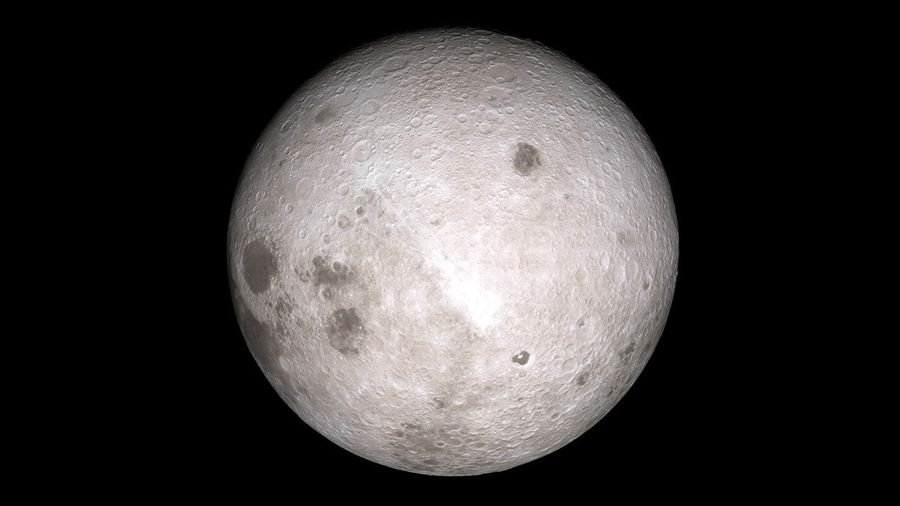
The far side looks very different from the face we see. Astronomers prefer the precise term far side. The near side is actually the darker-looking one on average because it is covered with large basaltic plains (the maria, or “seas”) that absorb more light. The far side is brighter overall, heavily cratered, and has a thicker crust with far fewer maria.
How do we know
- Luna 3 (1959): The Soviet probe took the first photographs of the far side. They were blurry, but they revealed the lack of large dark plains.
- Apollo missions (1968-72): Astronauts orbiting the Moon saw the far side directly. Apollo 8 crews were the first humans to do so.
- Orbiters: NASA’s Lunar Reconnaissance Orbiter (since 2009) has mapped the whole Moon in high resolution. Laser altimetry gives precise elevation, and gravity-mapping missions like GRAIL (2011-12) reveal the crust’s thickness and internal structure.
- Landers and samples: China’s Chang’e 4 landed in the South Pole-Aitken basin in 2019 and sent back data and images from the surface. Chang’e 6 returned samples from the far side in 2024, which let scientists directly compare their composition and age with near-side rocks.
Why does the myth exist
The phrase “dark side of the Moon” is old. In earlier usage, “dark” often meant “unknown” or “unseen,” not “unlit.” For most of human history the far side was a complete mystery, so the label stuck. Popular culture reinforced it — most famously Pink Floyd’s 1973 album The Dark Side of the Moon — and many people still assume the side we cannot see must be perpetually black.
Conclusion
The far side of the Moon is not a permanent night side. It has mornings, noons, evenings, and long nights just like every other part of the lunar surface. The myth confuses “hidden from Earth” with “hidden from the Sun.” Once you picture the geometry — Moon orbiting Earth while both circle the Sun — the “always dark” idea simply does not hold up.
Next time someone mentions the dark side of the Moon, you can smile and say: “It’s far, not dark.”