The famous sci-fi movie Alien 1979, “In space, no one can hear you scream,” is a staple of pop culture. It communicates a fundamental scientific reality. Deep space is a vacuum, and sound waves require a medium to travel. Without air, molecules cannot bump into one another to pass along acoustic vibrations.
However, the reality of “sound” in the cosmos is far more complex and fascinating than absolute silence. While humans cannot hear open space with their bare ears. The universe is actually filled with physical pressure waves, plasma oscillations, and electromagnetic signals that can be translated into sound.
Why Space is Silent
Sound is a mechanical wave. A pressure disturbance that travels through a medium by causing particles to vibrate and collide with one another. On Earth, air molecules are packed densely enough to transmit these vibrations efficiently to our ears.
Interstellar space is radically different. In interplanetary space, the average density is about five protons per cubic centimeter—a near-vacuum by terrestrial standards. With particles so widely separated, a pressure wave cannot form a continuous chain of collisions. The mean free path between particle collisions in interstellar space can be on the order of 0.01 light years. Any “sound” at such scales would have wavelengths vastly larger than anything human hearing could perceive, with frequencies measured in femtohertz. It will be far below the human hearing range of roughly 20 Hz to 20,000 Hz.
An explosion in the vacuum of space would produce light and radiation, but no audible sound would reach a distant observer because there is no medium to carry the pressure wave.
Where sound can exist in space
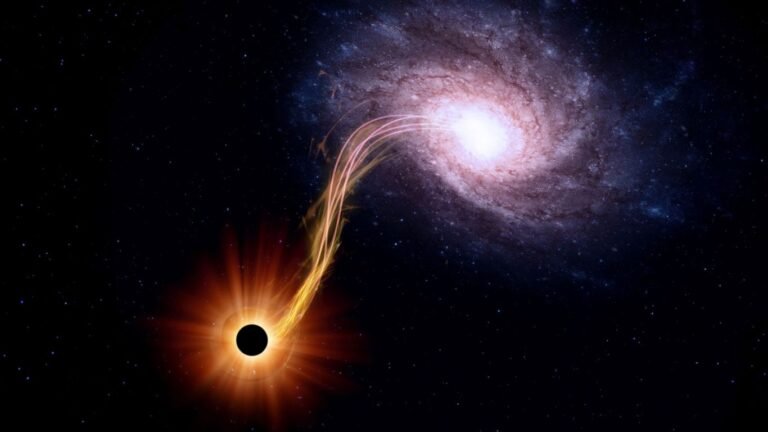
Galaxy clusters contain hot, diffuse plasma (the intracluster medium). In 2003, NASA’s Chandra X-ray Observatory detected pressure waves rippling through the gas in the Perseus galaxy cluster, driven by outbursts from the central supermassive black hole. These waves correspond to a note roughly a B-flat, 57 octaves below middle C, with a period of about 10 million years — far below the range of human hearing. In 2022 NASA released a sonification that shifted the frequencies upward by 57–58 octaves so people could hear a representation of them.
This is not the only case. The hot gas in other galaxy clusters similarly supports sound waves, and NASA has acknowledged that the idea of a completely silent space is, in their words, a “popular misconception” when applied to these dense environments.
Plasma waves, radio emissions, and sonification
Spacecraft detect more than just light and particles. Instruments aboard missions such as Voyager and Cassini also measure disturbances in plasma and electromagnetic fields.
Plasma is a state of matter made up of electrically charged particles, such as electrons and ions. These particles can behave collectively and support different kinds of waves. Although these disturbances are not ordinary sound waves travelling through air, spacecraft instruments can detect their electrical or magnetic signals.
Scientists can convert these measurements into audio signals, allowing us to hear patterns that would otherwise be impossible to perceive directly.
Another technique is called sonification, which converts scientific data into sound using specific mapping rules. For example, NASA’s 2022 sonification of the black hole in the galaxy M87 combined observations from the Chandra X-ray Observatory, the Hubble Space Telescope and the Atacama Large Millimeter Array. Different wavelengths were assigned different ranges of musical tones, while brightness controlled the volume.
These recordings are not actual sounds travelling through space. They are audio representations of astronomical data, allowing scientists and the public to explore information in a different way.
Sound in Other Environments: Planets, Moons, and the Early Universe
Space is not uniformly empty, and sound can exist wherever there is sufficient atmosphere or fluid. Planetary atmospheres support sound, though the experience would be different from Earth’s. On Mars, the thin carbon dioxide atmosphere causes sound to travel at about two-thirds the speed it does on Earth. The normal human voice would be lower in pitch and carry poorly. The Huygens probe recorded actual sound during its descent through Titan’s atmosphere—a rushing, wind-like noise, captured by an onboard microphone.
Even the early universe was a noisy place. Before about 400,000 years after the Big Bang, the cosmos was filled with a dense, hot plasma in which matter and radiation were strongly coupled. Sound waves—acoustic oscillations in this primordial plasma—propagated and left imprints on the cosmic microwave background radiation that we observe today. These imprints are a primary source of cosmological information, and some physicists have poetically called the pattern the “primal scream of the infant universe”.
Conclusion
For any human floating unprotected in interplanetary or interstellar space, the environment is silent. You would hear nothing from outside your suit. Science-fiction movies add sound effects for dramatic impact; real space is quiet in the acoustic sense.
Yet the universe is far from inert. It is filled with electromagnetic radiation across the spectrum, plasma oscillations, magnetic disturbances, and — in denser pockets — true pressure waves at frequencies we cannot hear. Space is mostly silent to our ears, but it is not a place of absolute stillness. Instruments reveal a rich, if mostly inaudible, acoustic and electromagnetic environment.
In short: space is silent enough that no one can hear you scream, yet active enough that astronomers can still “listen” to its deepest processes by other means.