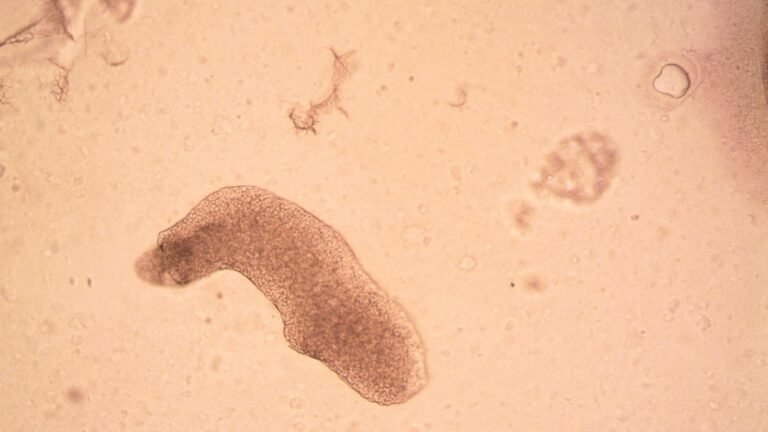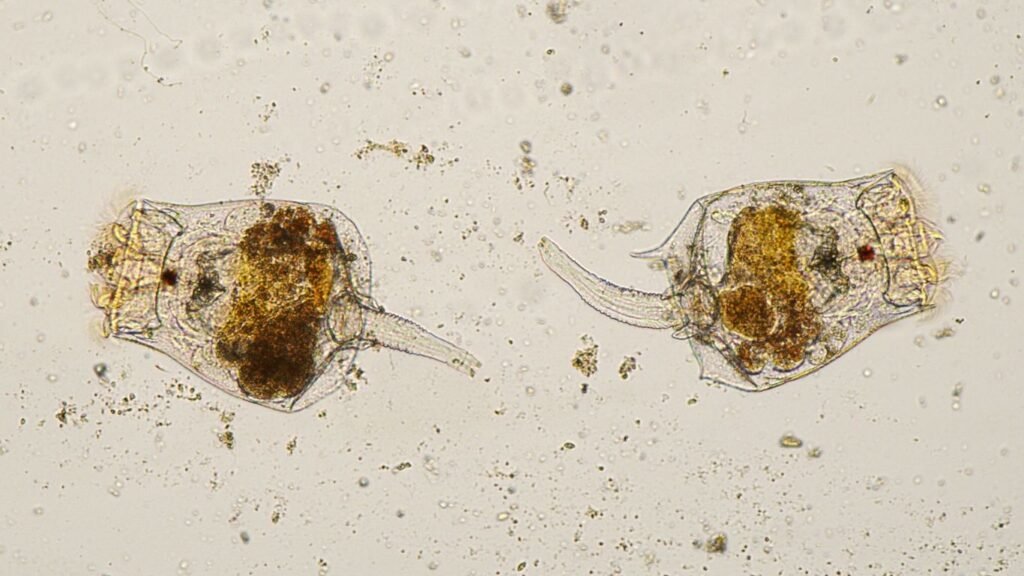
Rotifers are tiny multicellular animals that live in water and moist environments all over the world. They are often called “wheel animals” or “wheel animalcules” because of a crown of hair-like structures (cilia) on their heads that beat in a way that looks like spinning wheels under a microscope. Despite their microscopic size, rotifers have specialized structures for feeding, movement, digestion, and reproduction. Their complex anatomy makes them fascinating examples of how much biological organization can exist in a tiny animal.
What Exactly Are Rotifers?
Rotifers belong to the phylum Rotifera. Despite their tiny size, they are true animals with specialized organs, not single-celled microbes. Most measure 0.1 to 0.5 millimetres long—about the size of a period at the end of this sentence, or smaller. Some species are as small as 50 micrometres (six to eight times the size of a human red blood cell), while a few stretch longer than 2 millimetres.
A rotifer’s body has three parts: a head, a trunk and a foot. The head holds the corona, the trunk holds the organs, and the foot sits at the base. The name “rotifer” comes from Latin and means “wheel-bearer.” This refers to the corona, a ciliated structure at the front of the animal. When the cilia beat rapidly, they create a current that draws food toward the mouth, making it look like two spinning wheels. The wheels do not actually rotate; the illusion comes from the coordinated beating of the tiny hairs.
Where Do Rotifers Live?
Rotifers are found nearly everywhere there is water or moisture. The vast majority live in freshwater—ponds, lakes, rivers, temporary pools, rain gutters, and puddles. They also thrive in the thin films of water around soil particles, on mosses and lichens, in leaf litter, and even on other animals or plants. A smaller number live in brackish or marine environments.
They occur worldwide, from polar regions to the tropics. Some are free-swimming plankton, others crawl along surfaces in an inchworm-like fashion, and some are sessile (attached permanently to plants or other surfaces, sometimes living in tubes or gelatinous cases). About 25 species form colonies.
How Do They Move and Eat?
The corona is the star of the show. Rows of cilia beat in coordinated waves, creating water currents. This helps the rotifer swim and also draws food particles toward its mouth. Rotifers are filter feeders that eat dead material, algae and other tiny living organisms. The beating corona creates a current; the current carries particles to the mouth, and the mastax grinds them. Some species are hunters instead. For example, Asplanchna is a larger, carnivorous genus that preys on other rotifers.
How Do They Reproduce?
Rotifer reproduction is remarkably varied and includes some of the strangest biology in the animal kingdom.
- Bdelloidea (roughly 350–460 species): Reproduce only asexually through parthenogenesis. Females produce offspring from unfertilized eggs that are genetic clones of the mother. No males are known in this group.
- Monogononta (the largest group, about 1,500 species): Practice cyclical parthenogenesis. Under good conditions, females reproduce asexually for rapid population growth. When conditions worsen (overcrowding, temperature changes, etc.), they switch to sexual reproduction. Unfertilized eggs become short-lived, reduced males; fertilized eggs become tough resting eggs that can survive harsh periods.
- Seisonidea (only a few marine species): Reproduce exclusively sexually.
Resting eggs have thick protective shells and can remain dormant for years or even decades until conditions improve. Lifespans are generally short—often just a few days to a few weeks for active females.
Amazing Survival Skills
Many rotifers, especially bdelloids, can survive complete drying out through anhydrobiosis (a form of cryptobiosis, or “hidden life”). When their habitat evaporates, they contract into a compact, inactive form (sometimes called a tun), lose almost all body water, and essentially pause their metabolism. Some bdelloid rotifers have been revived after being kept dry for up to nine years. Separately, a 2021 study reported a rotifer recovered from Siberian permafrost dated to approximately 24,000 years ago.
When water returns, they rehydrate and resume normal activity within hours. They can also tolerate freezing (cryobiosis). This ability lets them live in temporary habitats that regularly dry up, such as mosses or seasonal pools.
Ecological Importance
Rotifers play a vital role in aquatic food webs. They consume bacteria, algae, and tiny particles, helping recycle nutrients and in turn serve as important food for larger invertebrates, crustaceans, and the larvae of fish. Because they are easy to culture and nutritious, certain species (especially Brachionus) are widely used in aquaculture as live feed for fish and shrimp larvae.
A Brief History of Discovery
Rotifers were among the first microscopic animals observed. Reverend John Harris may have described them as early as 1696. Antonie van Leeuwenhoek gave detailed accounts in 1702–1703 and was the first to note that some could revive after drying. It took until Christian Gottfried Ehrenberg’s work in 1838 for scientists to fully recognize them as multicellular animals rather than complex single-celled organisms.
Conclusion
Rotifers are microscopic multicellular animals famous for the wheel-like corona of cilia that gives them their name. Despite their tiny size, they possess complex organ systems, diverse lifestyles, and extraordinary survival abilities—including the power to dry out completely and come back to life. Found in nearly every moist habitat on Earth, these “wheel animals” are both ecological workhorses and biological marvels that show how complex life can be even at the smallest scales. They are a reminder that “animal” does not mean “large”—and that some of the hardest survivors on Earth are the ones you need a microscope to see.
Sources:
Rotiferes: Rotifera – Encyclopedia.com