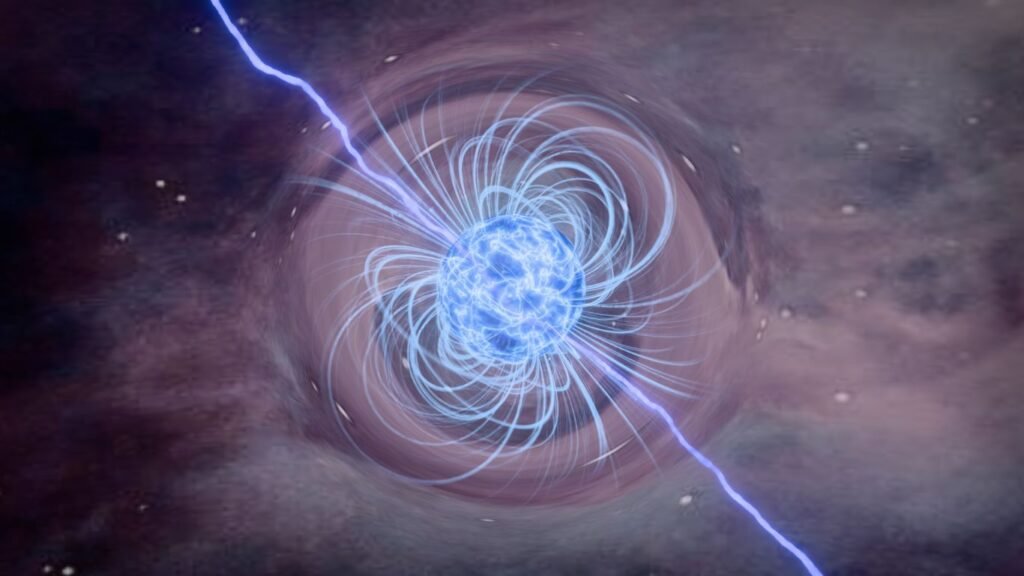
Imagine a stellar remnant the size of a city—roughly 20 kilometers (12 miles) across. It spins dozens or even hundreds of times per second, possessing a magnetic field trillions of times stronger than Earth’s. And sweeping intense beams of radiation across the cosmos with the precision of an atomic clock. These objects are called pulsars.
A pulsar is a rapidly spinning neutron star that emits beams of electromagnetic radiation from regions near its magnetic poles. As the star rotates, these beams sweep through space like the rotating light of a lighthouse. When one of the beams points toward Earth, astronomers detect a brief, regular pulse of radiation. The time between pulses equals the star’s rotation period.
Pulsars are among the most extreme and precise objects in the universe. Their pulses can be timed with extraordinary accuracy, making them natural cosmic clocks.
From Dying Star to Neutron Star
Neutron stars form when a massive star (typically 8 to about 20 times the Sun’s mass) exhausts its nuclear fuel and collapses during a supernova. The outer layers are blown away, while the core is crushed by gravity to nuclear densities.
The collapse does two crucial things. It squeezes the star’s original magnetic field into an intensely concentrated form. It spins the remnant up, much as an ice skater spins faster when pulling in her arms. A typical pulsar has a magnetic field of around 10¹² Gauss—roughly a trillion times stronger than Earth’s. Its mass is about 1.4 times the Sun’s, packed into a sphere roughly 20 kilometers across. A teaspoon of its material would weigh about a billion tons on Earth.
How Do Neutron Stars Make Regular Pulses?
The short answer is that pulsars don’t pulse. They spin. The regularity comes from the star’s rotation. The standard explanation is the rotating lighthouse model (also called the lighthouse or beam model), proposed soon after pulsars were discovered.
A neutron star’s magnetic axis is usually tilted relative to its spin axis. Powerful magnetic fields accelerate charged particles (electrons and positrons) to nearly the speed of light along the open magnetic field lines that emerge near the magnetic poles. These energetic particles produce beams of radiation—primarily radio waves, but sometimes also optical light, X-rays, or gamma rays—directed outward from the polar regions.
As the star rotates, that beam sweeps around like a searchlight. If Earth happens to lie in the beam’s path, we see a flash each time the beam passes by. The interval between pulses is simply the star’s rotation period. The Crab Pulsar, the remnant of a supernova observed in 1054 AD, spins about 30 times per second, so it flashes 30 times per second. Millisecond pulsars can spin hundreds of times per second; one known example reaches 700 Hz.
What is Still Not Understood
The exact details of how the radio emission is generated are still not fully understood, despite decades of study. Leading ideas involve curvature radiation, plasma instabilities, and cascades of electron-positron pairs created in the strong magnetic and electric fields of the magnetosphere. Higher-energy emission (X-rays and gamma rays) often originates in different regions, such as outer gaps in the magnetosphere.
Energy Source and Evolution
Pulsars are powered by the loss of rotational energy. The rotating magnetic field acts like a spinning magnetic dipole, radiating energy and also driving a wind of relativistic particles. This torque gradually slows the star’s spin, so pulse periods slowly increase over time (typically by tiny fractions of a second per year). The spin-down rate lets astronomers estimate the magnetic field strength and the pulsar’s characteristic age.
The Crab pulsar shows how this works. In 2007, it spun with a period of 0.0331 s and slowed at 4.22×10⁻¹³ s per second, giving a characteristic age near 1,240 years, while the true age from the 1054 supernova is about 950 years. The estimate is rough but usable. Over time, pulsars slow down and fade, and the pulsar radio emission eventually switches off.
Millisecond pulsars: recycled and extremely precise
Some pulsars spin hundreds of times a second. These millisecond pulsars are old stars that were spun up. The leading explanation is that a neutron star in a close binary pulls in matter from its companion, and the transferred angular momentum raises its spin to hundreds of rotations per second. That is why they are called “recycled.”
Discovery and Importance
Pulsars were discovered in 1967 by Jocelyn Bell Burnell and Antony Hewish through radio observations. The first detected signals were so regular that they were briefly nicknamed “LGM” (Little Green Men) before the natural explanation was confirmed. The ATNF Pulsar Catalogue listed 4,393 pulsars in its June 2026 release. China’s FAST radio telescope has led recent discoveries: it has found 1,284 pulsars, including over 170 millisecond pulsars, as of September 2026.
Pulsars serve as powerful tools in astrophysics:
- Precision timing tests general relativity (especially in binary pulsars).
- They act as natural laboratories for extreme physics (super-strong gravity, magnetic fields, and densities).
- Pulsar timing arrays are used to search for low-frequency gravitational waves.
- They help map the interstellar medium and study the structure of the Milky Way.
Conclusion
A pulsar is a spinning neutron star whose misaligned magnetic beams sweep past Earth, producing the regular pulses that give these objects their name. The lighthouse model elegantly explains the observations, even while some details of the emission physics remain an active area of research. These cosmic beacons continue to illuminate both the extreme conditions inside neutron stars and fundamental questions about physics and the universe.
Sources: