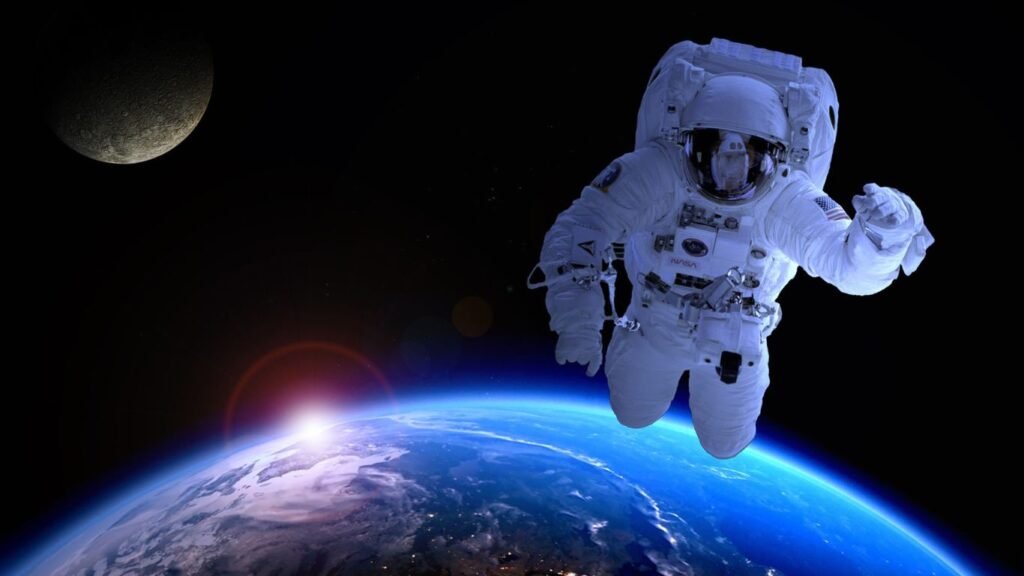
This is a very popular myth. Films like Total Recall and Outland made the exploding-body image famous, but it is not what physics or the evidence predicts. So the simple answer is No. A human body exposed to the vacuum of space would not explode. The reality, confirmed by physics, physiology, animal studies, aviation medicine, and rare human incidents, is far less cinematic but still lethal within minutes.
Why the Body Does Not Explode
Human skin and connective tissues are strong and elastic. They act as a natural pressure vessel capable of containing the roughly one-atmosphere pressure difference between the inside of the body and the vacuum outside. Soft tissues can swell significantly—potentially up to nearly twice normal volume—due to the formation of gas bubbles in body fluids, but they do not rupture or burst apart.
Blood does not boil in the circulatory system either. The closed network of blood vessels maintains internal pressure high enough that blood remains liquid at body temperature. The vapor pressure of water at 37 °C is about 47 mm Hg; as long as circulatory pressure stays above that level, blood itself does not vaporize. However, fluids in less-protected tissues can vaporize at sufficiently low pressures, leading to swelling and bubble formation. This process is known as ebullism.
What Actually Happens: the Sequence
The real killer: lack of oxygen
The more immediate threat is hypoxia. With almost no pressure outside, the air in your lungs rushes out, and oxygen leaves the blood instead of entering it. Oxygen-poor blood reaches the brain after roughly 9 to 12 seconds, and you lose consciousness. Aviation sources give about 9 to 12 seconds of “useful consciousness” above 50,000 feet, and a classic NASA-era reference work, the Bioastronautics Data Book, estimated that some consciousness would be retained for 9 to 11 seconds and that a person would have only 5 to 10 seconds to help themselves.
The breath-holding trap. Instinct says to hold your breath. That would be a serious mistake: as outside pressure collapses, air trapped in the lungs expands and can rupture lung tissue. Medical and spaceflight sources agree that the right response is to exhale and keep the airway open.
Temperature and other effects
Space itself has no temperature in the usual sense because it is a vacuum; heat transfer occurs mainly by radiation. The body does not freeze solid in seconds. Exposed surfaces may cool, and moisture can freeze or evaporate, but core body temperature drops slowly. In direct sunlight near Earth, unfiltered ultraviolet radiation would cause severe sunburn relatively quickly, but this is a secondary concern compared with oxygen loss and pressure effects.
Radiation from cosmic rays or solar particles is a serious long-term hazard for astronauts, but it does not cause instantaneous death upon exposure to a vacuum.
Real-World Evidence
The 1966 chamber accident
The best human data point is an accident. In 1965–1966 at NASA’s Manned Spacecraft Center, technician Jim LeBlanc was testing a spacesuit in a vacuum chamber when a hose disconnected. Pressure around him dropped rapidly to near-vacuum levels (around 0.1 psi). He remained conscious for about 14 seconds, felt the saliva on his tongue begin to boil, then lost consciousness. The chamber was repressurized within roughly 15 seconds. He survived with only minor, temporary effects (an earache and brief loss of taste sensation).
Animal experiments
Animal experiments from the 1950s and 1960s (primarily dogs and chimpanzees) and high-altitude aviation data produced consistent timelines. Consciousness lasts about 10–15 seconds, and recovery may be possible if pressure is restored within roughly 90 seconds, with worse outcomes beyond that.
Why the Myth is Still Relevant After Decades
The explosion imagery is a staple of cinema—from countless space thrillers. It is visually dramatic and intuitively “logical” to audiences who understand that space is a vacuum. The phrase “explosive decompression” itself contributes to the confusion. In aviation and spaceflight, “explosive decompression” refers to the speed of pressure loss (a cabin losing air in under half a second), not to the body exploding. The term describes the event, not the outcome for the person inside.
The myth also mixes different kinds of pressure damage. The lungs do rupture in real life if full of air, and that is a real and deadly injury. But the body as a whole does not burst. The distinction between a ruptured lung and an exploding torso is enormous, yet popular culture still uses it.
Conclusion
You would not explode, your blood would not boil inside your vessels, and you would not freeze instantly. Instead, you would lose consciousness in about 10–15 seconds from lack of oxygen, experience progressive tissue swelling from ebullism, and die within one to two minutes if not rapidly rescued and repressurized. The outcome is fatal without intervention, but the process is quieter and more physiological than the explosive Hollywood version. Spacesuits and pressurized habitats exist precisely because the vacuum of space is an extremely hostile environment for an unprotected human body.